Bridget Jones: Mad About the Boy

Director:Michael Morris

Writers:Helen Fielding, Dan Mazer, Abi Morgan.

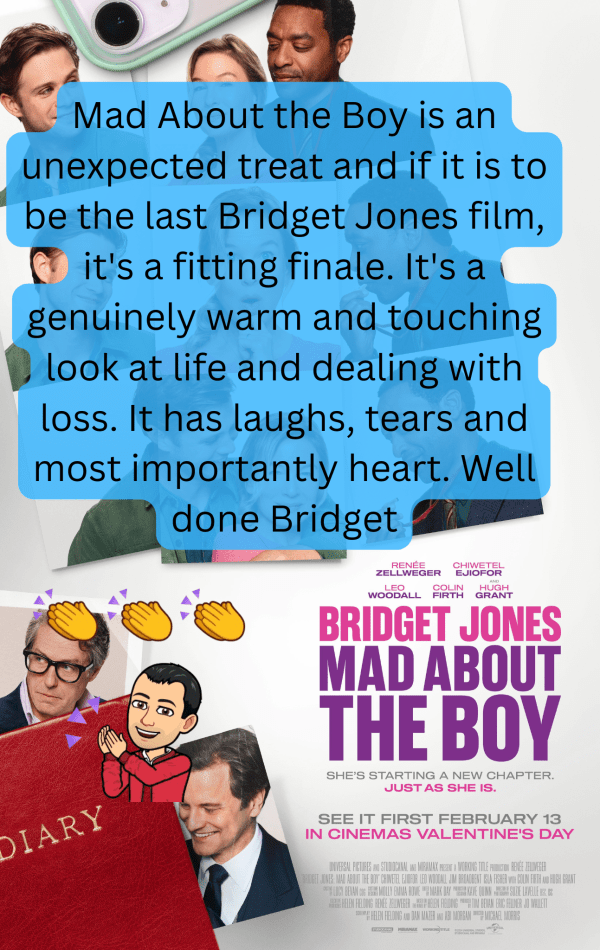
In this latest outing we find Bridget (Renée Zellweger) coming to terms with life as a widow and single mother. Encouraged by her friends she heads back to the world of TV production. Being back in the workplace opens up a new life and new chances for love,  there’s her childrens new science teacher, Mr. Wallaker (Chiwetel Ejiofor) and a park ranger Adonis, Roxster (Leo Woodall). But what seems new and exciting, maybe isn’t quite what Bridget hopes for, as she starts to realise what is truly important and how she wants her life to look.

Mad About the Boy was a surprising treat and if it is to be the last outing for Bridget, then it would be an extremely fitting one.

What works so well In this, is the way the story takes you by surprise. While it hints at been a typical Bridget outing, instead it flips that and turns into something unexpectedly warm and touching that looks at life, getting older, dealing with the most devastating of losses, and finding what makes you happy.

Zellweger is excellent again, bringing to life a character who, for all her ridiculousness, remains vulnerable, warm hearted and someone you care about. Alongside her there is a lovely mix of the returning,  characters, touching memories of long lost ones and the new. Chiwetel Ejiofor charms as the awkward but kind hearted teacher and Leo Woodall has fun as Bridget’s Adonis. But it’s Hugh Grant who continues his run of film stealing cameos, with a Daniel Cleaver who also realises that maybe he’s missed the important things in life.

It has lots of fun call backs that fans will enjoy. But it’s no lazy greatest hits, it a warm, sometimes funny, often melancholy and touching, look at life.

Mad About the Boy is an unexpected treat and if it is to be the last Bridget Jones film, it’s a fitting finale. It’s a genuinely warm and touching look at life and dealing with loss. It has laughs, tears and most importantly heart. Well done Bridget.

September 5

Writer/Director: Tim Fehlbaum

Writers: Moritz Binder & Alex David

The ABC sports team find themselves, while covering the 1972 Munich Olympics, thrust into the middle of a crisis as terrorists take 11 of the Israeli Olympic team hostage. As the only US TV crew on the ground, the team led by Roone Arledge (Peter Sarsgaard) and Geoffrey Mason (John Magaro), place trust in young head of operations Marvin Bader (Ben Chaplin) to cover the incident and tell a compelling story from the tragic events playing out in front of them.

While September 5 is centered around the tragic events that befell the Israelis, the story isn’t really about that. Rather, this looks at the attempts that a team, with no real news experience, makes to tell a story of unfolding human tragedy.

It does that in 95 minutes of tight, taught drama, which, while not in real time, feels like it is, speeding along, not really taking a moment to breathe, as the team reacts to the ever changing situation in front of them.

It also asks some interesting questions about news teams trying to balance how to tell a complex live story, that needs to balance the reality of impact on the real lives of those at its centre, with the need to get details and try to stay ahead of the competition. All of this, set against the politics of an Olympics and the cultural state of West Germany in 1972.

It’s a credit to the cast that, what could be a dry newsroom procedural, portrays the real tension of the situation, with the main cast supported well especially by Leonie Benesch and Zinedine Soualem.

The film looks great capturing the mechanical and manual nature of the technology available to tell a live story in 1072. It also makes extensive use of the real footage of both the broadcast and the hostage drama to provide authenticity.

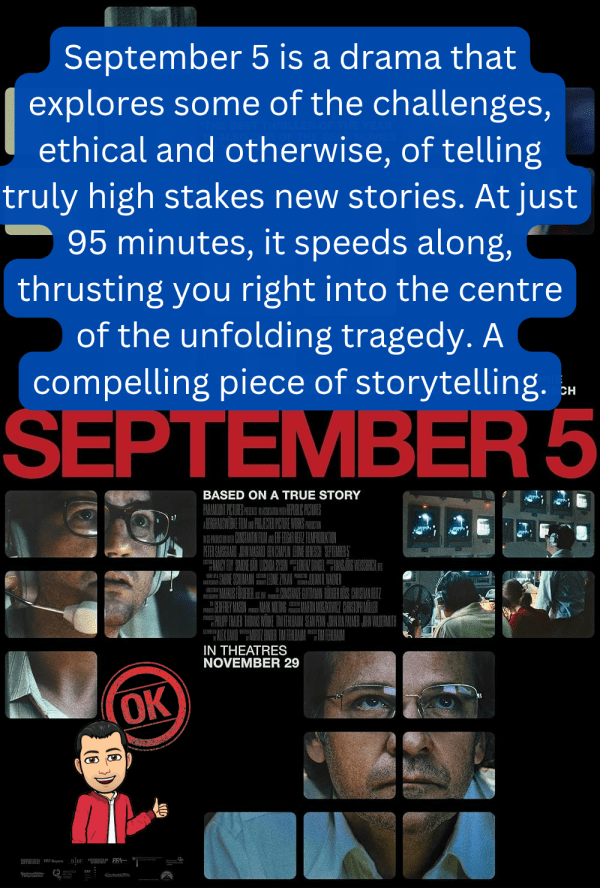
September 5 is a drama that explores some of the challenges, ethical and otherwise, of telling truly high stakes new stories. At just 95 minutes, it speeds along, thrusting you right into the centre of the unfolding tragedy. A compelling piece of storytelling.

Saturday Night

Writer/Director: Jason Reitman

Writer: Gil Kenan

Saturday Night focuses on the 90 minutes leading up to the first broadcast of what would become one of the most influential shows in comedy, Saturday Night Live. It gives us a behind the scenes look as creator Lorne Michaels (Gabriel LaBelle) tries to coral together his comedy troupe of unknowns into a show to be broadcast nationwide. He has to fight studio execs, producers, crew and the egos of his stars including Chevy Chase (Cory Michael Smith), John Belushi (Matt Wood) and Dan Akroyd. Can they pull it off and go live?

A bit like Saturday Night Live itself, this is a film that almost doesn’t work, but then by some unexplained miracle it just about pulls it off!

Shot as a behind the scenes docudrama, it attempts to capture the hectic energy behind the show that would revolutionise TV comedy. It spends most of its time following Michaels as he stumbles from crisis to crisis. Whether it’s Belushi. Chase, Billy Crystal(Nicholas Podany) trying to negotiate his slot or Jim Henson (Nicholas Braun) trying to find lines for his Muppets. He’s also fighting  execs and TV’s current guard such as Johnny Carson and Milton Berle (J. K. Simmons).  But this structure also means it never seems to get a handle on its story often feeling a little ill disciplined and confused. But what Reitman does well is pull it all together and a bit like SNL for all of the madness around it, when it all comes together it works a treat. And that’s a compliment for something that for quite a long time felt a bit of a mess.

While it doesn’t all work it does capture the anarchy of SNL well and you feel thrust into the middle of it all as the camera chases down hallways and into dressing rooms.

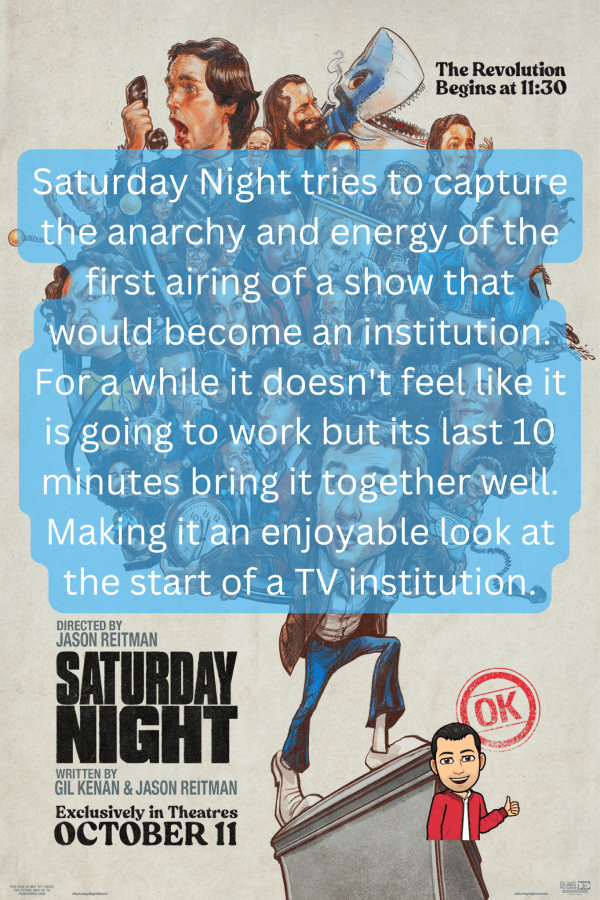
Saturday Night tries to capture the anarchy and energy of the first airing of a show that would become an institution. For a while it doesn’t feel like it is going to work but its last 10 minutes bring it together well. Making it an enjoyable look at the start of a TV institution.

Hard Truths

Writer/Director: Mike Leigh

Pansy (Marianne Jean-Baptiste) is angry at the world and those in it. Her anger shows in her vicious verbal onslaughts that are targeted at anyone or anything that crosses her path. From baby clothes with pockets and slovenly customer service, to her family. And it comes at a cost, her husband (David Webber) is distant, her son, Moses (Tuwaine Barrett) is as scared of the world as is mother is angry, and in a strained relationship with her sister Chantelle (Michele Austin).

For those expecting a comedy about Pansy and her cuttingly funny rants at the world may be disappointed. Because while Hard Truths has its comedic moments but her rants soon become uncomfortable as they quickly shift from funny to painful to watch. This is a much more about a woman who is angry, but it’s because she’s in pain, devastatingly sad and her rants, she hates as much as those on the receiving end. She is also scared, of the world around her, of being loved and of being alone. It’s exhausting to watch at times and you feel every minute of Pansy’s pain.

While this can be a hard watch at times, it’s hard in a good way. It works because of Marianne Jean-Baptiste’s performance. Without her, this could easily become too hard to watch. But she gives you someone you care hugely about. You feel all of her pain, her fear and her sadness. It’s a wonderfully layered performance. She’s well supported too, Tuwaine Barrett as Moses and Michele Austin as her sister.

It’s a film that looks at a small part of a life, it’s not a film with a resolution, or of big moments and for some this may be a problem. The last 10 minutes or so may be a bit divisive, but for me it’s a powerful and touching exploration of a life.

Hard Truths is a tough watch. But tough in the right way. Pansy is, for all her bluster and anger, scared and sad. But what could be a character that is to hard to watch is, thanks to Marianne Jean-Baptiste, a character you could easily dislike is one you truly care for and want to be happy. This is a sometimes funny, often dark but always touching piece of work.

The Brutalist

Writer/Director: Brady Corbet

Writer: Mona Fastvold

László Tóth is a Jewish immigrant, who having escaped his home country arrives in 1947 United States. He’s a talented well respected architect. But now finds himself alone, separated from his wife (Felicity Jones) and adopted daughter (Raffey Cassidy). His life in America changes when he meets the wealthy Harrison Lee Van Buren (Guy Pearce), who asks László to build a centre to memorialise his late mother. We follow his story, of building his epic masterpiece and all that happens during it.

The Brutalist is as angular, beautiful and impressive as one of László’s great structures.

It’s easy to talk about its epic scale, cinematography and pounding score. Or the fine performances, Adrian Brody is compelling and strongly supported by Pearce, Felicity Jones and Isaach de Bankolé, with an entire cast that is note perfect.

But what makes The Brutalist work is the depth of its story. It’s about the desperation of the displaced and the immigrant experience. It deals with power dynamics, as the powerful play out their follies on the backs of others, pulling dreams away on a whim. It is distinctly in two parts, before and after its intermission. The first, more hopeful about building a life, chasing a dream. The second starts beautifully, but is darker as the reality of the control of the powerful, bites deep. While the second half takes a few stranger turns, it is in its epilogue that is perhaps its most powerful moment, as László’s motive behind his work becomes clear and how he used his art to show defiance.

It is a film to admire, a sweeping cinematic experience, telling an epic powerful story.

The Brutalist is, like its architecture, an impressive piece of filmmaking. It’s a 215 minute epic that looks and sounds great, with a compelling central performance. But it’s the depth it covers that is most impressive. It’s about dreams, oppression, and control. It’s personal and broad. And at its heart is love and defiance. It’s a unique film, that’s worth every one of its 215 minutes.

A Real Pain

Writer/Director: Jesse Eisenberg

After the recent death of their grandmother, David and Benji (Jesse Eisenberg & Kieran Culkin) head on a road trip to Poland to join a Jewish history tour and better understand their grandmother’s homeland and heritage. The boys are very different, leading to a trip where they make some tough discoveries about their heritage and relationship.

A Real Pain is not particularly original it’s a traditional road movie, with two very different people, who have grown apart. But the reason the structure keeps getting used is, when done well, it works very well. A Real Pain does the road movie very well, it’s funny when it should be, melancholic when it has to be, uncomfortable at times, touching and a film full of heart.

It is built around the often strained relationship between David and Benji. David the married man with a child and a stable job, while Benji remains the free spirit who wears his heart on his sleeve, speaking without a filter. But both of them hide hurt and worry. And in Rosenberg and Culkin you have two perfectly cast performers who are believable and relatable, bringing humour, pathos and heart.

The two are well supported in the form of the tour group they meet in Poland with Will Sharpe, Jennifer Grey, Kurt Egyiawan, Liza Sadovy and Daniel Oreskes all used by the main characters to, in different ways, show difference and explore feelings and hurt. Each performance balanced just right.

The film is very well judged, none more so in its scenes at a concentration camp. Where it captures the poignancy of these horrific sites perfectly. With a thoughtful cinematic eye and gentle pace.

While A Real Pain is a traditional road movie, it’s an excellently done one. It’s funny, poignant and touching throughout and beautifully judged. Eisenberg and Culkin create two characters to believe in and care about, who take you on an enjoyable journey. A real joy of a film.

A Complete Unknown

Writer & Director: James Mangold

Writer: Jay Cocks

A Complete Unknown follows the early days of the career of the musical legend that is Bob Dylan (Timothée Chalamet). It starts in 1961 and his meeting  Woody Guthrie (Scoot McNairy) and Pete Seeger (Ed Norton). It follows Dylan’s journey from struggling musician, to star, via his relationships with Joan Baez (Monica Barbaro) and Sylvie Russo (Elle Fanning), the creation of his classic music and his run-ins with the “traditional” folk music scene. Concluding in his appearance at the 1965 Newport Folk Festival.

While I enjoyed this, for the awards buzz around it, it was a pretty pedestrian nuts and bolts biopic. It never does any more than takes a surface look at Dylan’s early career and relationships. The story beats seem no more than a time filler between recreations of Dylan’s music, rather than a chance to learn more about the man and his life.

Which is a pity, as the story let’s down Chalamet’s committed performance, turning it into a set of impressions of key Dylan performances. The supporting cast have mixed amounts to work with, Ed Norton perhaps has the most, but Elle Fanning and Monica Barbaro are both underused and under-explored. Scoot McNairy does manage to do a touching turn as a seriously ill Woody Guthrie.

But it’s this lack of depth in the story that leaves it all as no more than a celebration of Dylan’s work, rather than any kind of detailed look at the man and what drives him. While Chalamet delivers a performance that captures the “tortured genius”, the film also fails to really explore how that impacts those around him either.

A Complete Unknown is an enjoyable if, rather nuts and bolts biopic. It’s a celebration of Dylan’s classic back catalogue, but it never goes beyond that and you learn very little about the man, his motivations and relationships. It’s a bit of a pity as it fails to take advantage of Chalamet’s hard work in portraying Dylan. Enjoyable but a little unfulfilling.

Maria

Director: Pablo Larraín

Writer: Steven Knight

Maria is set in the final week of the life of legendary opera singer Maria Callas (Angelina Jolie). The story is set around Callas trying to come to terms with a body and, most crushingly, voice that is failing her. Trying to build her voice, so she can sing again, she does so while reflecting on her life, her childhood relationship with her mother and her relationship with Aristotle Onassis (Haluk Bilginer). All while coming to terms with her fading fame.

Maria is a melancholic, humourous, often tragic, but beautifully told story. It is helped by being set against the equally melancholic, beauty and power of opera.

It’s at its best when we focus on Callas and her struggles to come to terms with her fallibility. Told partly in flash back and more interestingly by her conversations with a film maker Mandrax (Kodi Smit-McPhee), a construct of Callas’s imagination. The strongest parts are here and in the relationship she has with her loyal staff, Farruccio (Pierfrancesco Favino) and Bruna (Alba Rohrwacher). Relationships that portray love, loyalty and anguish as those closest to her see all her frailty.

It revolves around Angelina Jolie’s excellent performance. Carrying off the balance between the elegant diva and broken and vulnerable older Callas perfectly.

The film looks great presenting the different eras in styles evocative of the filmmaking of that time. And of course it sounds great, blending Jolie’s vocals with the power of Callas’s real voice.

It only really falters when time is spent on her relationship with Onassis, which while important feels an unnecessary diversion, from the film’s strengths.

Maria is a beautifully told, melancholy and tragic telling of Maria Callas’s final days. It revolves around a perfectly judged performance from Angelina Jolie, carrying glamour and tragedy in equal measure. It’s operatic moments add wonderfully to the feel of the film. It’s not perfect, but it is a beautifully told often tragic tale.

We Live in Time

Director: John Crowley

Writer: Nick Payne

We Live in Time, follows the life of talented chef Almut (Florence Pugh) and data analyst partner Tobias (Andrew Garfield). It tells the story of their lives together from the first, painful meeting, through all of their relationship ups and downs. We see them juggle careers, different ambitions, family and most tellingly, the difficulties that come with challenging health problems. All through a series of vignettes, that capture their lives through its emotional, humourous and hard moments.

We Live in Time, is a film that doesn’t completely work, but has enough in it to keep you engaged. What most definitely works is its two stars, who, overcome the challenges the storytelling choices present, by being believable and engaging.

Florence Pugh’s Almut, takes you on a demanding journey, a driven and talented young woman, whose life is turned upside down by the hardest of health diagnosis. Her performance always demands your attention as she struggles with how to live a life and make an impact. Garfield is the right balance against Pugh’s powerhouse performance, a calm and quiet presence around which the story revolves. Together they are believable and very watchable.

What worked less well was the non linear storytelling, which, by using moments, means you never quite feel involved, a bit like watching a highlights reel. It is also very Almut centric, it feels like Tobias is merely a spectator, it never feels like we understand the true impact of Almut’s health on his or anyone else’s life. The story is such a powerful one, but those choices means you never quite feel fully drawn in and because of it its emotional climax falls a bit flat.

This is a film that doesn’t fully work, its non linear storytelling means you never quite feel fully invested. What does work is its two stars who are very watchable. Florence Pugh demands attention whenever she’s on screen and delivers another imperious performance. Not perfect and doesn’t quite deliver the emotional punch. But thanks to its two leads, watchable enough.

Nosferatu

Writer/Director: Robert Eggers

Newly married Thomas (Nicholas Hoult), is asked by his new boss Herr Knock, (Simon McBurney) to travel to Transylvania to meet with the mysterious Count Orlok (Bill Skarsgård) and sign the deeds on a new property. His new wife Ellen (Lily-Rose Depp) is panicked by the trip. Haunted by dark visions since her youth, she is terrified of the risk Thomas faces. Her fears are not misplaced, as Thomas finds a dark, foreboding castle and Count. The journey has not only placed him at risk, but also all of those back home. Thomas and Ellen, with help from Frederick (Aaron Taylor-Johnson), Dr. Sievers (Ralph Ineson) and Prof. Von Franz (Willem Defoe) must tackle the risk Orlok poses and save those he threatens.

This is a wonderfully dark, melodramatic, camp, gothic horror.

It is built around the obsession between Ellen and Orlok, their fates intertwined in ways they do not realise. And also.against a fear of the unknown, driven by superstition, but also the more contemporary fear of an unknown plague, sweeping through the land.

The story telling is wonderfully gothic. It is often melodramatic in a way only gothic horror can be. It is tense and dark, creating an unease and fear that is wholly absorbing. And when it needs to, it produces bloodlust and gore.

It is built around its two central performances. firstly Skarsgård’s Orlok, who thrives in the shadows. But it’s  Lily-Rose Depp that steals the show. Seen as nothing more than a girl haunted by her melancholy, she grows as she realises the responsibility and part she plays. Delivered with a fabulous physical performance.

It is beautifully shot and blends colour and monochrome seamlessly to show the shadow Orlok casts. It’s dark streets, high towers and imposing buildings, a masterclass in gothic horror.

Nosferatu is a wonderfully dark, melodramatic, Gothic horror. It is built on a wonderful performances by Lily Rose Depp and the darkly imposing Bill Skarsgård. It looks incredible and builds an atmospheric world that is often tense and fabulously gory when needed. Brilliantly enjoyable.

Blog at WordPress.com.

Up ↑

Design a site like this with WordPress.com
Get started