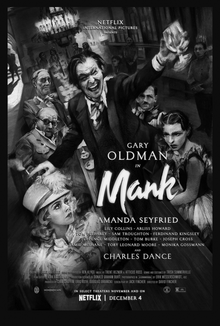
New to Netflix.
David Fincher’s first film since 2014’s excellent Gone Girl is the story of Herman J. Mankiewicz, based on a script by Fincher’s late father Jack, as he works to complete the screenplay to Orson Welles’ classic Citizen Kane, for which they would both win an Oscar. The story is told through the eyes of Mank, as he races to complete his 300 page plus script while recuperating. Shot entirely in black and white the film is told through a series of flashbacks from the early to mid 1930’s that share the parts of Mank’s life that influenced and motivated him to tell the story of Kane.
Here’s the thing, technically this is a fantastic film, beautifully shot with its use of black and white (shot on monchrome camera’s so no colour print exists) and the single track audio help capture the feel of a 1930’s period movie and, while it takes some getting used to, once you do it helps to absorb you into the story telling.
However, with such a significant use of flashback if, like me, you don’t know the story or the references to Hollywood’s big names of the 1930’s it can become bewildering very quickly! Throughout the first 2/3rds of the story I was spending a lot of time trying to figure out who was linked to who, why it mattered and what did this have to do with Citizen Kane!? But at that 2/3rds point it clicked into place, why Mank saw Hollywood, the wider United States and global issues as he did (this was the 1930’s with a World War and the rise of fascism on the horizon) and why the uncontrolled influence of men like William Randolph Hearst (the inspiration for Kane) was damaging wider society. Once the story clicked the whole thing made sense and what had been confusing and at times difficult to engage with became a coherent and interesting story.
The cast is strong throughout, Gary Oldman is excellent in the title role, Lily Collins’s Rita, Tuppence Middleton as Mank’s wife and Amanda Seyfried as Marion Davies, the key female influences in the story all offer good support.
As you’d expect from Fincher the film is well made and as I mentioned earlier the smart use of “retro” technology really helps to put you in the right “time and place”, that use of a single sound track throughout is particularly noticeable and equally very smart. It is this kind of creative freedom that Netflix seems to offer and you can fully understand why it’s hugely attractive to directors like Fincher.
While for me Mank took maybe 90 minutes for it to come together, I’m glad it did, because what it delivers is a fascinating slice of 1930’s life, a look at some of the questions that troubled society at the time and the dangers of uncontrolled influence. It’s well worth a watch, be patient, I think it’s worth it.




 shortfilmreviews