Cry Macho

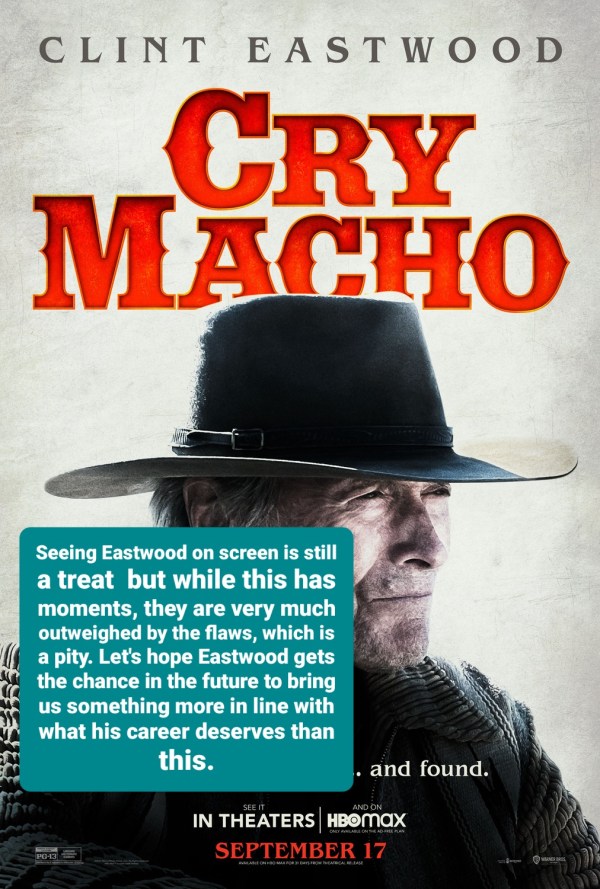
Directed by and starring Clint Eastwood and written by Nick Schenk is this adaptation of N. Richard Nash’s novel. Eastwood Is Mike Milo a former rodeo star and horse breeder. His best days are behind him, after injury, and then drink brought on by the loss of his wife and son. When he’s approached by his former boss Howard (Dwight Yoakam) to travel to Mexico and collect his son Rafo (Eduardo Minett) from his ex and sons mother and bring him to Texas. Milo accepts and after finding Rafo, a teenager who has gone off the rails, the two head off through Mexico to the US border on a journey that teaches them about each other, trust, friendship and family.

Clint Eastwood remains one of cinemas greatest screen presences a true giant. However, not even Eastwood can save this extremely nuts and bolts, coming of age, self discovery road trip film. It’s dialogue is horribly clunky, some of the performances far from convincing and the plot itself is pretty ludicrous.

Eastwood is, as always, extremely watchable, but his casting is also a bit of a problem as we are asked to believe that not only is a 90 year old man the best option to bring home his son. We also still get him attracting women, one 50 and one 40 years his junior. That aside, Eastwood brings us his stock, grumpy, world weary character, but one who does asks questions about the cult of “macho”, the danger of wasting time, growing old and regret.

The relationship between Milo and Rafo does have its moments and the story does come from a good place. But the films flaws, its slow pacing, clunky dialogue, bizarre moments of exposition and less than convincing performances far outweigh the positives.

Seeing Eastwood on screen is still a treat and because of that I wanted to like this much more than I did. But while it has moments, they are very much outweighed by the flaws, which is a pity. Let’s hope Eastwood gets the chance in the future to bring us something more in line with what his career deserves than this.

The Colour Room

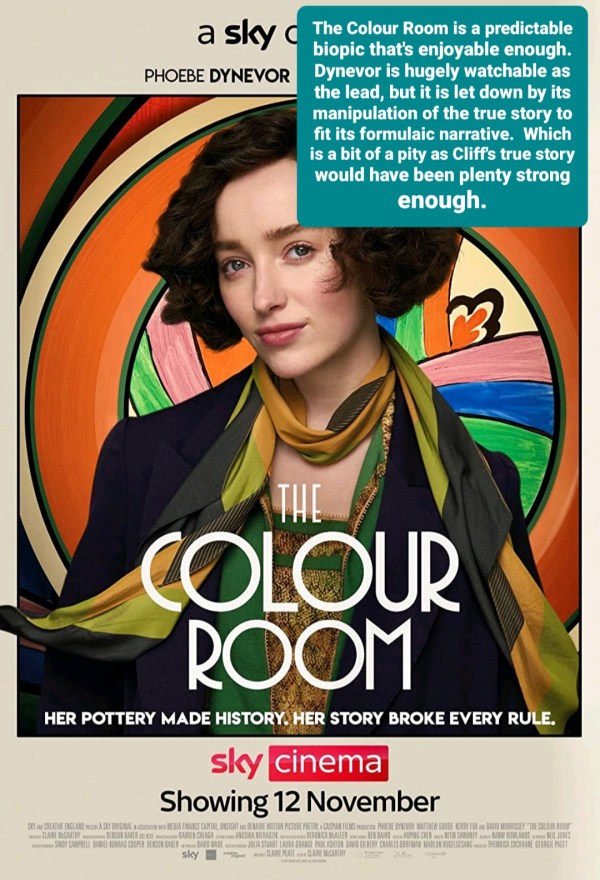
Directed by Claire McCarthy and written by Claire Peate is this biopic of revolutionary ceramic artist Clarice Cliff. Phoebe Dynevor plays Cliff, who we find as a young girl learning her craft moving between the pottery firms of early 20th century Stoke-on-Trent. She finally finds herself at Wilkinson’s run by brothers Colley (Matthew Goode) and Guy (Luke Norris) Shorter. It is here her talent is discovered and her career takes off. Cliff is talented, creative, ingenious and smart and the story follows her struggles for acceptance, the challenges of changing a traditional and male dominated industry which is busy telling its female market what it should like. It follows Cliff’s early career taking us into the 30’s including the beginning of her relationship with Colley.

The Colour Room is a very much (excuse the pun) paint by numbers biopic. We see Cliff’s ingenuity and determination shining through, portrayed through a watchable and enjoyable performance by Dynevor. But we also see the manipulation of Cliff’s actual story to fit a predictable biopic narrative. This includes the standard biopic struggles as Cliff’s bold designs fail to sell and the subsequent determination to fight back, not be beaten and ultimately gain success.

It is this predictable narrative and shoe-horning of plot devices, including a focus on the beginning of her affair with Colley, which detracts from what would be a fascinating enough story without the manipulation to fit the predictable story arc.

Performances are enjoyable with Dynevor very watchable in the lead, well supported by Goode, David Morrisey, Kerry Fox and Darci Shaw particularly. And the film, especially in its first half, is an intriguing look at life in the early 20th century and a really likeable portrayal of Cliff’s intelligence, drive and creativity. Sadly this was let down a little in the 2nd half as the film fell victim to its predictable narrative, altering a lot of the Cliff story to fit it.

The Colour Room is a predictable biopic that’s enjoyable enough. Dynevor is hugely watchable as the lead, but it is let down by its manipulation of the true story to fit its formulaic narrative. Which is a bit of a pity as Cliff’s true story would have been plenty strong enough.

Eternals

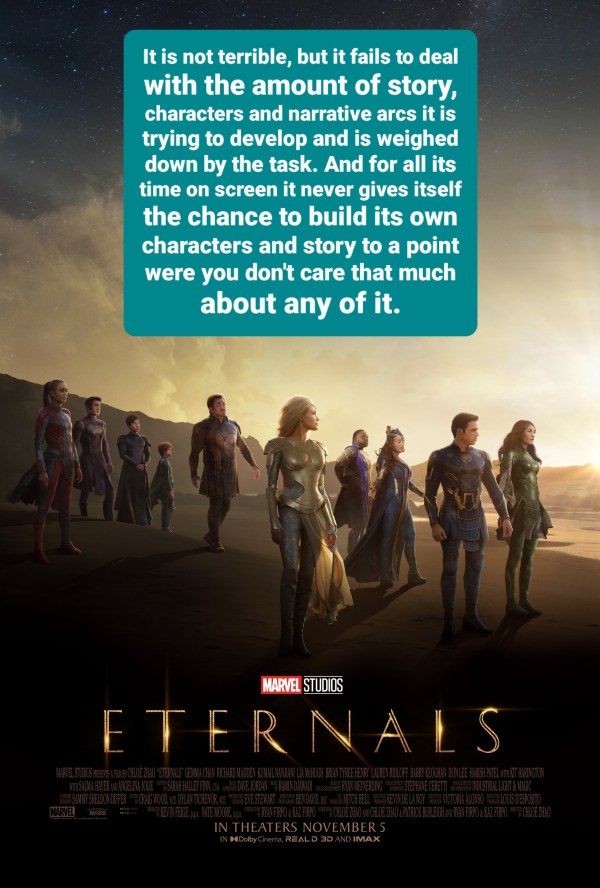
Directed by Oscar winner Chloe Zhao, is the latest in the Marvel universe fourth phase films. The Eternals are a group of other world immortal beings sent to earth 7000 years ago by their leader Arishem to protect humanity from a group of evil “deviants” who want to destroy all intelligent life. The group led by Ajak (Salma Hayek) and include the mighty Ikaris (Richard Madden), warrior Thena (Angelina Jolie) and Gemma Chan’s Sersi amongst their number. When they feel they have finally rid the earth of deviants, Ajak sets the group free to spend time learning about humanity until they are called. They spend 1000’s of years hiding amongst humanity, never to interfere, until present day, in a post “blip” world the Eternals come together to fight a new deviants threat.

It feels from early on the Eternals is being asked to do a lot of MCU heavy lifting, introducing a wide array of new characters and possibly setting up a range of story threads. And unfortunately it creaks and ultimately cracks under the weight of that Marvel universe plot building.

The film wasn’t a complete write off for me, there were things I enjoyed. There was some fun with Kumail Nanjiani’s Kingo and Ma Dong-Seok as Gilgamesh lightning the mood. And it does some interesting things with the Eternals themselves, making them fallible and ultimately asking questions about their own purpose.

But that’s not enough to overcome its problems. The challenge of trying to introduce so many characters and storylines leads to a disjointed film and ultimately gives us too many new characters to try and care about to a point were you struggle to care for any of them.

With so much to cover, Eternals is long and while I didn’t have a problem sticking with it, it’s clunky narrative made it difficult to engage with fully.

It is not terrible, but it fails to deal with the amount of story, characters and narrative arcs it is trying to develop and is weighed down by the task. And for all its time on screen it never gives itself the chance to build its own characters and story to a point were you don’t care that much about any of it.

Last Night In Soho

Edgar Wright writes and directs his latest musical and visual treat.

Last Night in Soho is part psychological thriller part ghost story that sees us flipping between contemporary London through the eyes of fashion student Ellie (Thomasin McKenzie) and the dark underbelly of 1960’s Soho. Ellie is a quiet girl from England’s South West, living with her gran (Rita Tushingham) since the death of her mother. Ellie is a gifted designer given her chance to attend university in London. But she also has the ability to feel and sense history and still sees visions of her mother. After moving out of her student accommodation she finds herself a tenant in the home of elderly Miss Collins (Diana Rigg). It is here that she finds herself linked back to 1960’s London as she sees visions of Sandie (Anya Taylor-Joy) a young girl trying to make herself a name as a singer. As she falls under the control of Jack (Matt Smith) her dreams unravel and she finds herself driven into a world she didn’t want and Ellie is dragged into it with her.

Last Night in Soho is a fabulous atmospheric thriller cum ghost story. Directed with Wright’s usual visual flair and ability to build around an enjoyable 1960’s soundtrack.

For me if you are going to do “horror” then this is how you do it. No need for jump scares, it is much better done with a clever story and intriguing characters you are never quite sure of. And a plot that keeps you unsure of what you think you know.

A couple of unconvincing accents aside the performances are superb Mackenzie and Taylor-Joy whose lives are intertwined, via some very smart editing, are at the heart. Mackenzie balances the fish out of water country girl with the determined young woman desperately trying to save Sandie. Taylor-Joy’s Sandie goes on the opposite journey from hopeful and fiesty to downtrodden and defeated. Matt Smith as ominous controlling Jack in the 60’s and contemporary Terence Stamp bring an uncomfortable under current when on screen. But all are topped by deliciously dark performance by the late Diana Rigg.

Last Night in Soho is a really enjoyable thriller cum ghost story, told with Wright’s usual flair. The plot is smart and wends its way smartly between today and the 1960’s and as the past encroahces increasingly on Ellie’s present it slowly ratchets up the tension. I went in knowing very little about this, but very much enjoyed finding out.

Dune (Part One)

Denis Villeneuve directs this new adaptation of Frank Herbert’s seminal sci-fi novel Dune. Set a long way in humanities future Paul Atreidis (Timothee Chalamet) is the son of Duke Leto (Oscar Issac) and Lady Jessica (Rebecca Ferguson) destined for greatness by taking over as the leader of one of the universes most respected families. When the planet, Arrakis, is left by its former leaders the Harkonnens, Atredis is asked to take over. However, Arrakis comes with danger, as the home of the universes most sort after resource “Spice”. Because of this Leto fears that malevolent forces are at work. Before heading to Arrakis, Paul realises his destiny goes beyond his own family and is linked to Arrakis and their indigenous people the Fremen.

Let’s get to it, Dune is spectacular an epic in the very best traditions of epics. Its scale Is huge and is truly magnificent as it moves its way through Herbert’s clearly complex novel.

What Dune does brilliantly is prove their is most definitely room for grown up sci-fi, it doesn’t all have to be explosion filled action packed adventures. Dune takes its time to build its story and the magnificent world it inhabits. It’s science fiction as it should be told, with patience, intrigue and intelligence. This patience completely vindicates Villeneuve’s decision to make Dune a two part story (Although part two is yet to be green-lit) as it allows him to take time to build the characters, their worlds and delve into the complexity of their existence.

The performances throughout are wonderfully judged. Chalamet and Ferguson are at the heart of the film and are both magnificent. But there is not one member of the star studded cast wasted, regardless of the amount of time on screen. Zendeya, Javier Bardem, Stellan Skarsgard, Josh Brolin the list is endless but every single one delivers an important part of the jigsaw.

It looks magnificent and Hans Zimmers score both help to envelop you in the world on screen. Maybe the highest praise I have is that at 2hr40 long if someone offered me 2hr40 of part two straight after I would of quite happily jumped right back into this wondeful on-screen world.

In my opinion with Dune Villeneuve has created a true master piece of science fiction cinema. A modern epic, its story, peformances, visuals and soundscape are incredible. And perhaps my best advice is this is a truly big screen experience, so if you can watch it there. Treat yourself and see it properly, roll on part two.

Another Round

Now available on VOD platforms.

Thomas Vinterberg writes and directs this story of four teachers who, worried their lives are drifting and unfulfilled, discover an unproven scientific theory. The theory is based on humans having too low a natural alcohol blood level and by raising the level, rather than impeding, actually enhances performance. The four friends Martin (Mads Mickkelson), Tommy (Thomas Bo Larsen), Nikolaj (Magnus Milling) and Peter (Lars Ranthe) decide to put it to the test. Initially the experiment seems to support the hypothesis, but as it unfolds and inevitably unravels, we see alcohol both masking and exacerbating the friends issues.

Winner of the best international film at the 2021 Oscars, Another Round is a black comedy, set in Denmark (and in Danish). It isn’t a film about “laddish” behaviour or four middle aged men trying to rediscover their care free alcohol fuelled partying younger selves. It is much smarter than that and while it would be wrong to say it’s not about exploring the impact and culture of drinking, it isn’t just about that. It equally spends time exploring the issues each of the men have in their lives, exploring difficult relationships, dealing with parenthood, loneliness and depression.

It is funny when it needs too be and not afraid to explore the darker aspects of the story when it has to, parking the humour effectively when necessary.

Built around four excellent performances that intelligently explore drinking and its impacts, both negative and positive. My only qualm was in the second half, I wanted a clearer take on the directors view of alcohols impacts, but the film chooses not to judge and that’s OK.

Another Round is about drinking culture but if you are looking for a Danish The Hangover, this isn’t that film. It’s an examination of the life of its four main characters, their hopes and ambitions as well as their frustrations and disappointments. Funny and touching throughout, its a smart look at its sometimes difficult subject matter.

Dear Evan Hansen

Stephen Chbosky directs this screen adaptation of Justin Paul’s award winning stage play. Evan (Ben Platt) is an awkward, anxious and lonely high school kid, heading into his senior year. Given an exercise by his therapist to try to help, he has to write himself a daily letter to visualise the day he wants. Evan’s life changes when one of his letters is the only thing found with the body of troubled student Connor who tragically takes his own life. Although he tries to explain, when he sees it provides some comfort to the family he plays along. When Evan provides a touching eulogy at a memorial service, he finds his is finally heard and seen. However, when the inevitable happens and the charade unravels, all must deal with the consequences.

I’ve never seen the stage play but reading through reviews from those that have, it seems that the issues with the adaptation are embedded in its source material. Because Dear Evan Hansen is a very uneven film.

Its first half is much stronger than its second, it tackles some hugely difficult subjects, Evan’s mental health challenges and loneliness, the concerns of his mother (Julianne Moore) and of course the devastation, heartbreak and loss felt by Connors family when he takes his own life.

It is in this first half that it as its best, the raw emotion on show is truly heartbreaking at times. The pain, confusion and desire to find something good to cling onto are brilliantly portrayed by Danny Pinto, the always wonderful Amy Adams and a fabulous performance from Kaitlyn Dever, who portrays the struggles of devastating loss versus the relief that a painful and difficult relationship with her brother is over.

However, as Evan’s deception unravels, this is where the film unravels with it. It doesn’t really seem sure how to handle the fallout of the discovery and rather clunkily heads towards its convenient ending.

The film does deal with some very difficult areas and raises it in a sensitive way. Amandla Stenberg’s Alana is used particularly well, especially highlighting how those needing help can often hide it so well.

But overall it doesn’t quite work, the second half let’s down its powerful first. And of course there is the Ben Platt issue who, while only 26, is bizarrely made to look even older and this constantly jars. Which is a pity, because Platt is a good performer, but has his job made difficult.

Dear Evan Hansen is hugely uneven, a touching and heartbreaking first half is let down by a meandering second that is unsure how to deal with its story. Which is a pity as there are things to enjoy and performances to admire, but overall it doesn’t work as well as it needs to for its difficult subject matter.

The French Dispatch

Wes Anderson writes and directs this latest entry into his unique cinematic world. The French Dispatch is a supplement in a 1960’s Kansas newspaper that tells its home audience the tales of a small French town Ennui-Sur-Blasé. Those tales are told through the eyes of its ex-pat American writers. They talk of life’s great joys art, love and food. The film itself is built upon five vignettes. An introduction through the cycling tales of Owen Wilson’s Sazerac, Tilda Swinton’s Belzerac covers art, Frances McDormand’s Krementz’s story has love; Jeffery Wright is Roebuck Wright, food journalist and seemingly budding crime author. All book ended by an obituary to the Dispatch’s editor and owner Arthur Howitzer Jr (Bill Murray) whose will dictates his magazine should die with him. The film provides us with the magazines essence through its three main stories covering the history of the French town that is its home.

There is no doubt that Wes Anderson has a style of film making and if you like them then you keep enjoying them, for their colour, humour, eccentricity and the beautiful artistic vision that he puts on the screen. If you don’t like that, then that’s unfortunate.

Luckily for me I do and The French Dispatch, is full on Anderson. Its appearance is stunning, its stories eccentric and humour engaging. A visual feast that made me happy.

Each story is an individual work of art, some working better than others, but each very watchable with an almost endless list of cinematic talent appearing. Some with major parts, such as Benicio Del Toro’s wonderfully eccentric and unhinged Moses Rosenthaler, who discovers his artistic genius in prison. Timothee Chalamet as Zeferelli a poet cum revolutionary. Through to the wondeful ensemble of A-list stars who queue up for the tiniest appearance, Willem Dafoe, Saoirse Ronan and Christoph Waltz amongst others.

The whole thing comes together beautifully. Sharing life in a sleepy French town, that seems mundane and unassuming, but with a little bit of exploration is full of fascinating stories, art, love and food. Highlighted at the end of the final story, as Wright muses how we are visitors just trying to find that little “something”.

If you don’t like Anderson’s style this is not going to change your mind. But for me it was a visually arresting joy from start to finish. Every scene beautifully crafted, outstanding performances, and a script full of whit and charm that transports you to a world that doesn’t really exist, but is a joy to spend some time in.

The Last Duel

Ridley Scott directs this true story of the last officially sanctioned duel in France. Set in the late 14th century it tells the story of Marguerite De Carrouges (Jodie Comer), the wife of squire and Knight, Sir Jean (Matt Damon). Sir Jean is a violent and effective soldier a respected fighter in the Kings forces. Jacques Le Gris (Adam Driver) is a squire and friend of Sir Jean, they have fought together and have a strong bond. However, this is broken as Le Gris becomes a trusted aide to Count Pierre d’Alençon (Ben Affleck) which reaches a peak when Le Gris is granted land, gifted to Sir Jean as part of his wife’s dowry. However, when the two meet at a celebration, there is a truce. But it is here Le Gris meets Marguerite and is attracted to her, which ultimately leads to his unwanted attention and a visit to her home and rape. Marguerite wants justice, she gets her husbands support, and when Le Gris denies it and a show trial exonerates him, Sir Jean takes it to the King, who grants him the right to duel Le Gris to the death.

The story is an epic and fascinating tale, told in an interesting three act structure, with each act told from the point of view of the main protagonists. Each is written by a different writer, Damon, Affleck and Nicole Holofcener and this gives them a subtly different voice and they all leave room for interpretation.

However, this is not only a sword fighting epic full of blood and guts. While at times there are spectacular and visceral action scenes, none more so than the violent and bloody duel at the films climax. It is more interesting when asking thoughtful and intriguing questions, especially around the reality of a women’s life in the 14th century. Even in her own version Marguerite realises she is nothing more that property to be traded by the men in her life.

The stella cast deliver, Comer in particular, who could’ve easily been overshadowed by Damon, Affleck and Driver, shines. With a powerful performance, showing strength, vulnerability and pain in equal measure. Amongst the male cast Adam Driver as Le Gris stands out and feels most at home in the 14th century.

It is two and a half hours long, but for me it uses the time well telling its story patiently and engagingly.

A fascinating story cleverly told, the three act structure allowed the Last Duel to do something different with the historic epic. It’s epic feel, fine performances and visceral action set pieces provided an intriguingly watchable drama, Well worth a watch.

Venom: Let There be Carnage

Tom Hardy returns as Eddie Brock, investigate reporter and host to symbiote Venom. Andy Serkis is at the helm as Eddie tries to resurrect his career and is given the opportunity to tell the life story of serial killer Cletus Cassidy (Woody Harrelson). However after a final visit to see him in prison, Cassidy gets his own taste of Venom and Carnage is born. As Carnage goes on the rampage Brock and Venom are having thier own problems, which they need to put behind them to save San Francisco from Carnage and his childhood sweetheart Frances Barrison (Naomie Harris). Who has her own revenge mission against Stephen Graham’s Detective Mulligan.

Sound like a lot of clunking parts that worryingly may not come together In a coherent film? You’d be right. Now, I quite liked the first Venom film, I liked its darkness, off the wall humour and the dual personality of Hardy as Brock and Venom. While, I appreciate that wasn’t the popular view, I had hopes that they would learn from the criticism and deliver in this one. Unfortunately they did not.

It’s a bit of a mess of a film. The storyline is paper thin, as are the characters. It’s big and loud and extra smashy, but in the super hero film way where nothing really matters, the action just feels like big CGI creations doing battle. Bad guy wants revenge, minor peril comes to friends of main character, they face off in a CGI fest battle, has been done many times before but so much better.

It’s not a complete write off, some of the humor remains and there are some enjoyable set pieces. But much of what worked first time around for me, didn’t hit the mark here. While the Venom/Brock dialogue had occasional fun, it often felt out of place and like a random voice over thrown into a scene.

The cast are fine Harrelson chews plenty of scenery, Harris brings a little something, as does Graham and the always reliable Michelle Williams, but they really have little to work with.

Then there is the post credit sequence. It clearly opens the door to another Venom appearance but my overwhelming feeling was that the preceeding 90 minutes had existed for the purpose of that sequence and really they needn’t have bothered.

Let There Be Carnage lived up to its name but not in a good way. Disjointed and predictable, the action lacking real weight and while the humour was enjoyable it was infrequent. Venom will clearly be back, but I’d rather this film had existed on its own merit not as a rather tedious setup for another Venom appearance elsewhere.

Blog at WordPress.com.

Up ↑

Design a site like this with WordPress.com
Get started