Belfast

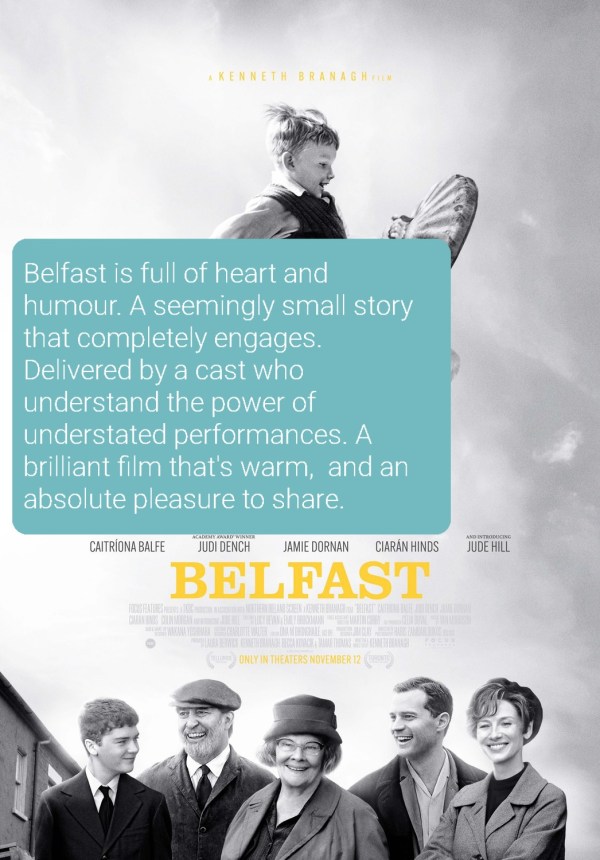
Written and directed by Kenneth Branagh is this semi autobiographical story set in his Belfast childhood. Buddy (Jude Hill) is a 9 year old, whose life is changed when a group storm down his street, attacking the homes of his Catholic neighbours at what is the beginning of the “troubles”. But this is just a backdrop to the story we follow and care about, Buddy’s life. How he sees his Ma (Caitriona Balfe) and Pa (Jamie Dornan) deal with Pa’s need to work away from home, financial worries and concerns for him and his brother (Lewis McKaskie) growing up in an unstable and dangerous Belfast.

Belfast is a brilliant piece of storytelling, it may well drift into rose tinted territory occasionally, but that’s a minor quibble over what is a fabulous film.

Its real strength is the juxtaposition of the seeming smallness of Buddy’s story against the scale of the troubles. It mostly uses the troubles as background noise, just another part of life among the things that are important to him. Growing up, his crush on a girl, his Granny (Judi Dench) and Pops (Ciaran Hinds), his family and friends.

The films charm lives in those details, its humanity and humour, set against the violence and the distrust embodied by Colin Morgan’s Billy Clanton. It’s how personal stories that are small in the bigger picture are so significant in the context of a family, something we can all relate too.

Beautifully shot in black and white, with occasional splashes of colour from those experiences that transport Buddy elsewhere, Chitty Chitty Bang Bang, a stage version of a Christmas Carol. A use of low angles show Buddy’s world and patient close ups add to the story telling.

The performances are as you’d expect in a Branagh film. But the star is 10 year old Jude Hill, bringing to life a cheeky kid, finding his way in a world that has changed overnight, but yet is still familiar, with a glorious charm.

Belfast is full of heart and humour. A seemingly small story that completely engages and commanfs your attention. Delivered by a cast who understand the power of understated performance. A brilliant film that’s warm and an absolute pleasure to share.

Save the Cinema

Director Sara Sugarman brings to the screen this, based on a true story, film about the attempts to save a local community theatre in Carmarthen, Wales, with the help of Jurassic Park. Samantha Morton plays Liz Evans a local hairdresser, which also uses the local theatre to host her youth choir. When the council led by the Mayor (Adeel Akhtar) decide to back a property developers plans to demolish the theatre, Liz is driven to action to save the theatre. Supported by retired teacher Mr. Morgan (Jonathan Pryce), Mayoral assistant, Susan (Erin Richards) and local postman Richard (Tom Felton) who use the theatres cinematic history to drive a new audience that to it. Topped by trying to secure a showing of Jurassic Park to coincide with its London premiere.

The ironic thing about Save the Cinema is how un-cinematic it is alongside the fact that it is only likely to be seen on streaming services. It feels like a made for TV drama and oddly for something based on actual events seems to have story holes in it big enough to drive one of Spielberg’s dinosaurs through.

Alongside the storyline is a range of paper thin characters, non more so than what Akhtar is given to work with, with the Mayor, only missing a moustache to twirl.

Critisicms aside it’s not a terrible, there is a certain charm to it and in the second half there is a lovely message about the importance of theatres to a local community. As well as a beautifully done scene where the community come together to watch a showing of “How Green is my Valley”.

The main performances are all fine, Morton doing most of the work, but she and the supporting cast do the best they can with a shaky script.

Save the Cinema is unremarkable and un-cinematic. But it is also inoffensive and not without some charm. Perhaps most importantly it does remind you of the importance of the communal experience that is cinema and a film that does that has something going for it. If it’s a wet weekend afternoon and there’s nothing else to watch well there is.

Licorice Pizza

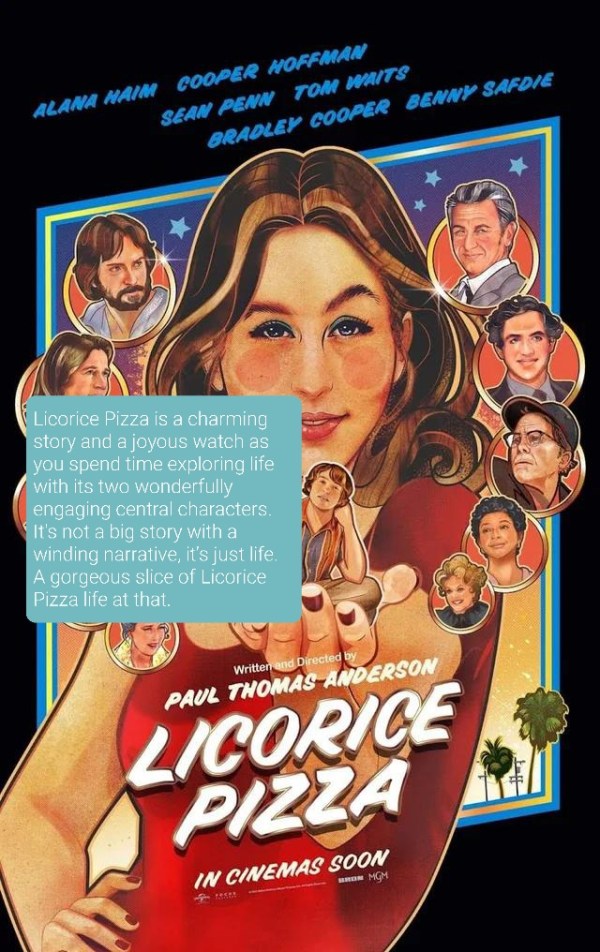
Paul Thomas Anderson writes and directs his first film since 2017’s Phantom Thread. Set in the San Fernando Valley in 1973 we have a kind of coming of age tale. Gary Valentine (Cooper Hoffman) a confident 15 year old, a TV actor and entrepreneur with a PR company under his belt and always looking for the next opportunity. Alana (Alana Haim) is in her mid 20’s and drifting, unsure of what she wants. They meet in the queue for Gary’s high school year book photographs and Gary talks Alana into a “date”. From there we follow their journey of growing up, starting to understand who they are, what they want and what they want from each other. All via a set of quirky stories including water beds, pinball machines, mayoral elections and runaway trucks.

I’m a real fan of films about life and its ebbs and flows they are often the most satisfying. And Anderson brings lots of ebbs and flows to the screen in what is a lovely watch.

It is quirky and, for the most part, a warm and charming story. Built around two stella first time performances from Hoffman and Haim. They are not your usual stars of a coming of age story, but it is their unique quality, quirky nature, warmth and engaging presence that makes their awkward coming of age slash love story work so well. It is built around their story, together and apart. The supporting cast is great with (the award nominated cameo) Bradley Cooper, Sean Penn, Tom Waits and a well hidden John C. Reilly. But it is when Gary and Alana are together the films shines most.

Its look and soundtrack, as well as slices of nostalgia from oil blockades to water beds and pinball. All helps capture a wonderful feel of 70’s California.

It isn’t perfect, it runs a little long, driven mainly by occasional detours to stories that didn’t quite work for me. But overall it is full of charm and heart.

Licorice Pizza is a charming story and a joyous watch as you spend time exploring life with its two wonderfully engaging central characters. It’s not a big story with a winding narrative, it’s just life. A gorgeous slice of Licorice Pizza life at that.

The Tragedy of Macbeth

Now on Apple TV+.

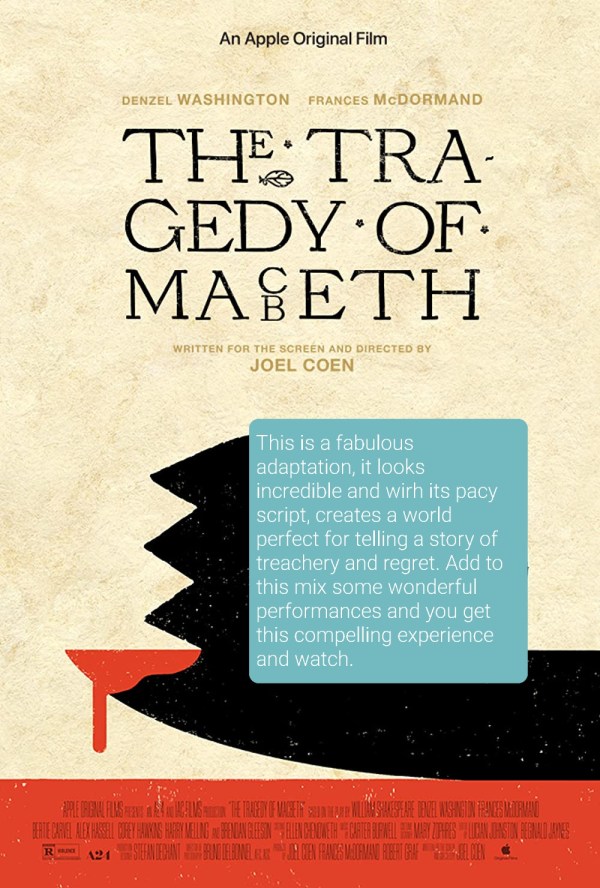
Joel Coen adapts and directs this latest  cinematic outing for Shakespeare’s story of ambition, betrayal, madness and suicide. Denzel Washington is the titular Macbeth who after a meeting with three witches, all played with a brilliant physical and unsettling performance by Kathryn Hunter, finds himself on a path of ambition, greed and treachery. A treachery driven by his wife Lady Macbeth (Frances McDormand) who has no time for her husband’s conscience. When King Duncan (Brendan Gleason) comes to visit their home, she demands Macbeth takes action. But it is action that leads to the Macbeth’s being eaten by remorse and regret as their enemies circle to regain Scotland’s crown.

There is a warning that we shall get out of the way that this is an adaptation that is heavy on Shakespearean text and imagery. So if that’s not your thing you may it hard going. For everyone else, settle in to Coens fantastic film.

Firstly it looks incredible Coen and his cinematographer Bruno Belbonnel creating a wonderfully immersive world. Shot in black and white and 4:3 ratio it feels very reminiscent of Bergman and Wells. And it is used to great effect ramping up the feeling of the world closing in on the murderous acts of the Macbeth’s.

The story is equally tight, Coen stripping back the text to give us a fast moving story the flows effortlessly through its plot points.

In Washington and McDormand you get fabulous performances, McDormand particularly. They are well supported, Gleeson cast perfectly as Duncan, as is Alex Hassel as Ross, constantly in the background scheming and manipulating. And Corey Hawkins as Macduff helps deliver a wonderfully visceral battle with Macbeth in the films final act.

If there is a reservation it is that it may be too hard work for some, which is a pity.

For me though this is a fabulous adaptation, it looks incredible and with its pacy script it creates a world perfect for telling a story of treachery and regret. Add to this mix some wonderful performances and you get a compelling experience and watch.

Being The Ricardos

Written and directed by Aaron Sorkin is this biopic of the couple who revolutionised the TV sitcom Desi Arnez and Lucille Ball.

Sorkin tells the story of three major events in their lives concentrated into a fictional week of filming of the TV behemoth that was “I Love Lucy”. Throughout the week we see Ball’s drive and creative genius, Arnez’s creative and business skills, strained cast and crew relationships, small minded views of executives and sponsors and the determination of Ball and Arnez to use their influence to change them. All of this set against a background of the American communist witch hunts of the 1950’s.

In true Sorkin style the film tries to handle a lot. Taking events that in reality were spread over years into one fictional week. And this is probably the films weak point, with so much covered it often only skims over events which in themselves could have warranted the focus of the film.

That said, I found plenty to enjoy. I’m not part of the generation or from the country where I Love Lucy was a cultural icon. However, its iconic status is such that its name and those of its stars have more than transcended borders and time. And it was this slice of their lives and careers that was interesting to me.

The film is built around its four core characters and it’s in their interactions that the film shines. Nicole Kidman gives a fine portrayal of determination and vunrabilty alongside nice comedic timing as she delivers Balls quick wit. Javier Bardem as Arnez acts as the perfect foil. But the show is often stolen by J.K. Simmons’s William Frawley the cynical heavy drinking co-star who alongside Nina Arianda’s Vivian Vance challenge, Ball particulaly, about her behaviour and treatment of those around her. It is these relationships that are the heart of the film.

While its over stretching is its weakness, it is compensated by some fine performances, a witty script and its fascinating subjects. This alongside the look and feel of the world Sorkin recreated added up to an enjoyable story about a fascinating couple.

The Lost Daughter

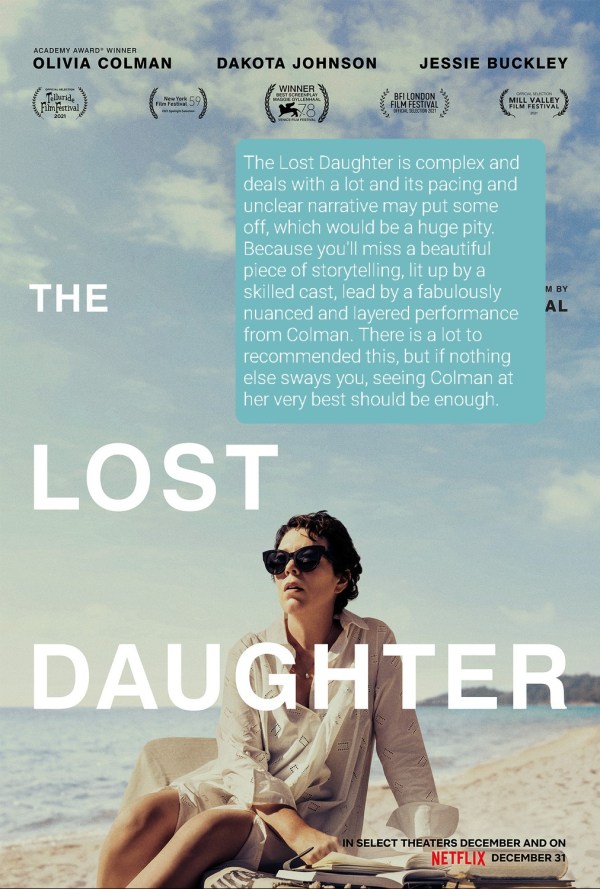
Directed and written by Maggie Gyllenhaal is this adaptation of Elna Ferrante’s novel. Olivia Colman is Leda a literature professor on a working holiday on a Greek island. Her peaceful beach rest is shattered when a large family arrive loud, brash and rude. Things change when one of the group Nina’s (Dakota Johnson) daughter vanishes from the beach. Finding her doesn’t end the stress, as the loss of her doll upsets both her and the whole family. As Nina struggles to handle what’s going on around her. This triggers memories from Leda’s own life her own challenges bringing up her girls and the impact of some of her decisions on all of their lives.

The Lost Daughter is a complex, interesting and thoughtful look at sadness, regret and the pressures posed by the idea of “the natural” mother. It is built around a stunning performance by Olivia Colman who engages completely every minute she’s on screen a character with a past, an internal strife and desperation that never quite reaches the surface. She is more than ably supported by those around her and none more than by the increasingly impressive Jessie Buckley as the young Leda. Buckley potrays brilliantly her struggles as she battles with the desire for a career and a life against the expectations of motherhood. Dakota Johnson completes the trio of impressive leads as Nina, a reflection for Leda of her younger self, equally struggling with the expectations of motherhood.

The Lost Daughter is a complex story, it moves patiently without grandstanding. Everything is subtle and delivered via understated, excellent performances. Which really worked for me.

The Lost Daughter is complex and deals with a lot and its pacing and unclear narrative may put some off which would be a huge pity. Because you’ll miss a beautiful piece of storytelling, lit up by a skilled cast, lead by a fabulously nuanced and layered performance from Colman. There is a lot to recommended this, but if nothing else sways you, seeing Colman at her very best should be enough.

Don’t Look Up

Don’t Look Up is Adam McKay’s latest satire. Leonardo DiCaprio is Michigan University professor Randall Mindy, Jennifer Lawrence PhD candidate Kate Dibiaski, who discovers a comet heading towards Earth in what will be an extinction-level impact. Taken to the White House to meet the President (Meryl Streep) and her Chief of Staff (Jonah Hill) to explain the impending collision, they are surprised to find convincing the President and the wider world of the planet-killing event is more difficult than they expect. With self-interest, misinformation, apathy and a media more interested in celebrity relationships all getting in the way of making clear the need to act.

I’ve enjoyed a lot of McKay’s work previously especially his expose films, The Big Short and Vice which shine lights in dark corners of the establishment. The reality of events they portray really engaged me. But the fictional premise here did lessen the impact of Don’t Look Up.

That’s not to say that this is a film that I didn’t enjoy or has nothing to say. The comet acts as a metaphor for our impending environmental crisis and McKay hammers home a cutting look at modern society. A morally bankrupt government who in the face of facts that show the impact of their stupidity, deflect, encourage division and distract with bluster. A shallow media, people swayed by online theories over facts. All have you shaking your head at the absurdity of it. However, as I mentioned the fictional premise and some rather long storytelling do lessen the stories impact.

While the message is less than subtle the all-star cast is a joy to watch delivering it. And while the comedy doesn’t hit every time it does more often than not. And to its credit, it doesn’t shy away from the consequences of letting the idiots win in a touchingly shot ending.

Don’t Look Up didn’t have the impact of some of McKay’s other films, it is overly long and lacks some of the intelligence of something like The Big Short. But there is a message In there for us all and enough to keep you shaking your head and, worryingly, laughing at the absurdity of the world we have created.

The King’s Man

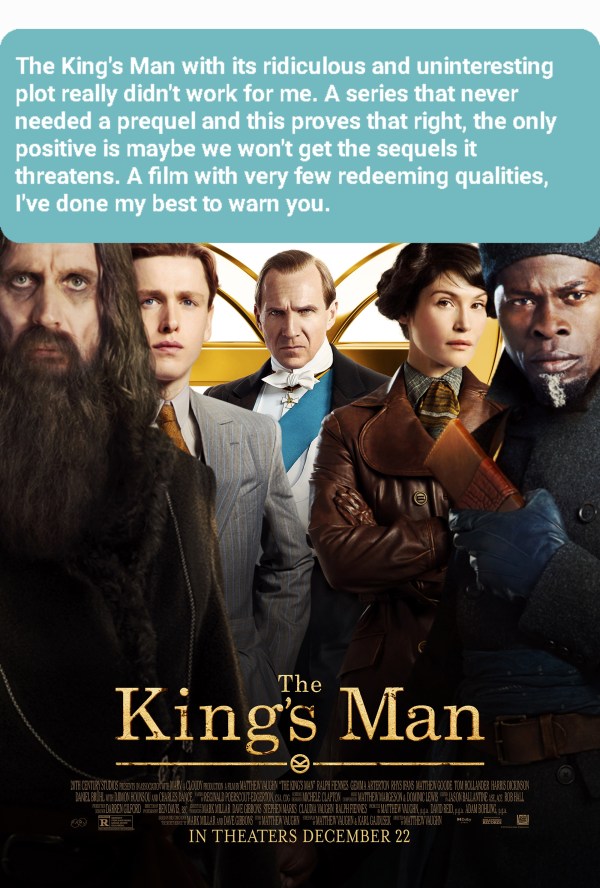
Written and directed by Mathew Vaughn is this prequel to Vaughn’s own Kingsman movies. Ralph Fiennes is The Earl of Oxford, who we meet in Boer War South Africa, representing the Red Cross and looking to put right the wrongs of the British army under Lord Kitchener (Charles Dance). However, it is here that Oxford and his son Conrad’s lives are changed forever. When we meet them 12 years later, Europe is on the edge of the first world war and, now grown, Conrad (Harris Dickinson) is desperate to serve his country much to his father’s displeasure. When Oxford is asked to go and chaperone Arch Duke Ferdinand, Conrad discovers his father and his faithful staff Polly (Gemma Arterton) and Shola (Djimon Hounsou) may have another way to serve King and Country. It is here they discover that a number of world events are being manipulated by influential people under the control of a shadowy leader “The Shepherd”. The task for Oxford is to find him and bring an end to the war.

Sound preposterous? You’re not wrong, it is complete nonsense from start to finish, problematic nonsense at that. It spends its time clumsily trivialising historical events to move forward a plot so ludicrous that by the end I didn’t care what happened, who it happened to or why.

Not everything fails miserably however, Gemma Arterton and Djimon Hounsou bring some fun and likeability to the cast. Rhys Ifans probably steals the scenes he’s in as Rasputin. There is also some subtlety to the 1st World War scenes in the trenches. And the final showdown manages a little humour. But its positives were certainly outweighed by the negatives.

The King’s Man with its ridiculous and uninteresting plot really didn’t work for me. A series that never needed a prequel and this proves that right, the only positive is maybe we won’t get the sequels it threatens. A film with very few redeeming qualities, I’ve done my best to warn you.

West Side Story

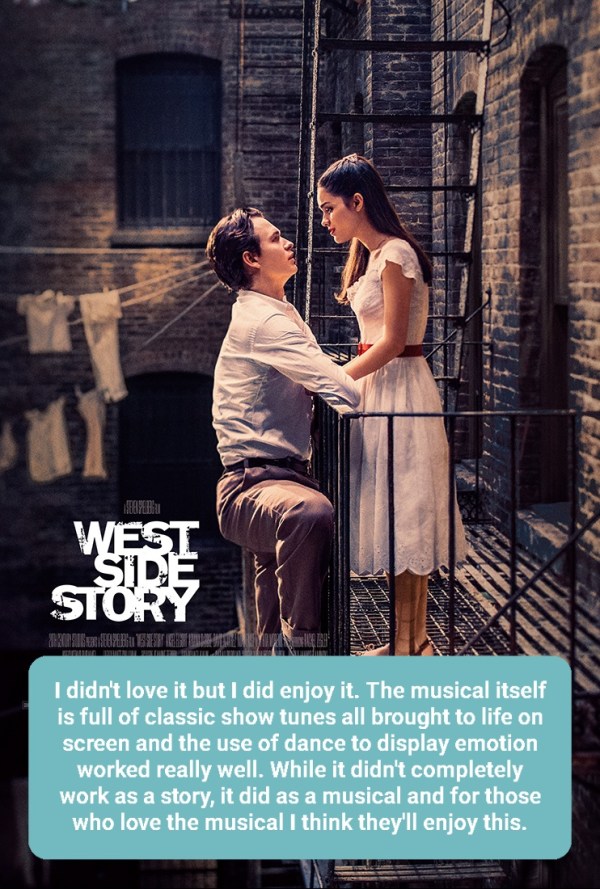
Steven Spielberg directs the latest screen adaptation of West Side Story. Set in 1950’s New York and based on Romeo and Juliet we find our star crossed lovers Tony (Ansel Elgort) and Maria (Rachel Zegler) who live on different sides of a gang war between The Jets, a group of New Yorkers who feel displaced by the incoming Puerto Rican community and their gang The Sharks. And it’s Tony and Maria’s relationship that threatens to escalate the tensions into a full-scale violent turf war that will end in bloodshed.

Unlike many, I didn’t come to this with experience of its previous cinema outings or stage show. The story still feels very relevant with its focus on displacement, gentrification, the problems of disaffected groups and the sad futility of gang violence. But alongside this is optimism, dreams to chase and attempts to escape the past, particularly for Maria’s friend Anita (Ariana DeBose).

However, for me, there is a problem with the story, its final act, which creates a story arc for one character which left me feeling cold about them and ultimately the films emotional climax.

Reservations aside, there are plenty of positives. There is no surprise that Spielberg can put together a musical, which is wonderfully shot and moves at a rapid pace, even for its 156 minutes running time. And of course the music, even for someone not familiar with the show, Maria, America, Tonight are all classics, America is a particularly joyous performance. Alongside the music, I also enjoyed the use of dance in the way it portrayed tension, optimism and energy.

Performances are enjoyable and also retain a level of their stage show roots, that works well. Elgort, and DeBose particularly carry the stories emotional heart.

While I didn’t love it, I did enjoy it, the plot issues aside there is an interesting story at the film’s heart. It is full of classic show tunes all brought to life on screen and the use of dance to display emotion worked really well. While it didn’t completely work as a story, it did as a musical and for those who love the musical I think they’ll enjoy this.

The Unforgivable.

New on Netflix.

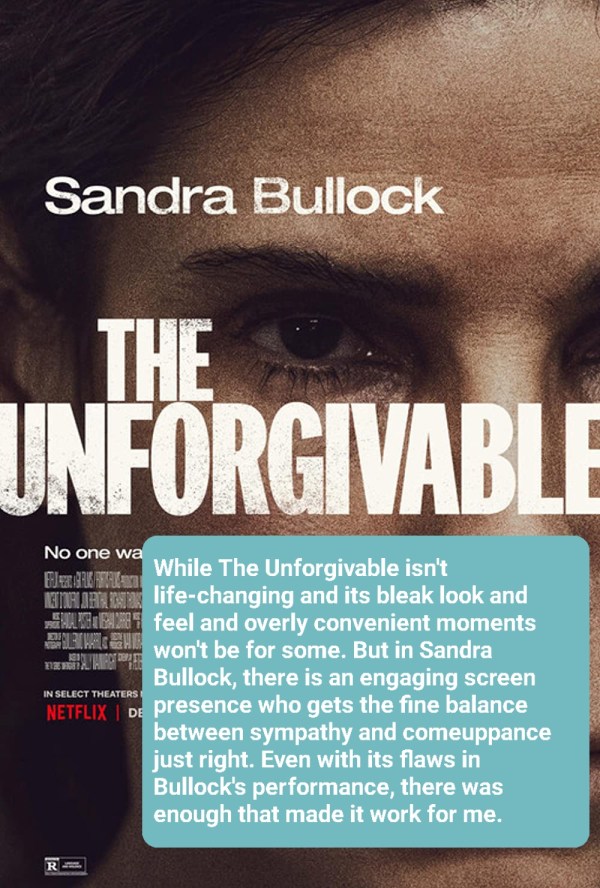
Directed by Nora Fingscheidt, Sandra Bullock stars in this gritty drama about the inability to forgive. Bullock plays Ruth Slater, just released from prison after serving 20 years for the murder of a policeman. Which happened while protecting herself and her young sister, whom she had raised, from eviction from the family home. Housed in a halfway house under the guidance of her parole officer Vincent (Rob Morgan), she tries to rebuild her life. This includes trying to understand what happened to her younger sister, Kate. However, her history haunts her, literally in the case of the two sons of the murdered cop, Steve (Will Pullen) and Keith (Tom Guiry), who are not ready to forget or forgive.

There was a lot for me to enjoy here, even with some rather less than subtle plot contrivances to deliver some redemption. That aside, the story paints an interesting image of the struggle for forgiveness, be it by those wronged or the perpetrators’ inability to forgive themselves.

Bullock is excellent in the lead; she is engaging and believable as she portrays the downtrodden Ruth, who has no interest in seeking forgiveness from those around her and accepts that second chances are not a right.

There is also some good support, Jon Bernthal, as Blake who tries to befriend her. Vincent D’Onofrio and Viola Davies as John and Liz, a lawyer and his wife, who purchase Slaters’ childhood home and offer her support in her darker moments.

The film does have issues, though. The plot contravence discussed earlier jars with the heart of the story, almost introducing a new film for the last 30 minutes. There are also a few too many swift character reappraisals of Ruth, which stretch credibility.

While The Unforgivable isn’t life-changing and its bleak look and feel and overly convenient moments won’t be for some. But in Sandra Bullock, there is an engaging screen presence who gets the fine balance between sympathy and comeuppance just right. Even with its flaws in Bullock’s performance, there was enough that made it work for me.

Blog at WordPress.com.

Up ↑

Design a site like this with WordPress.com
Get started