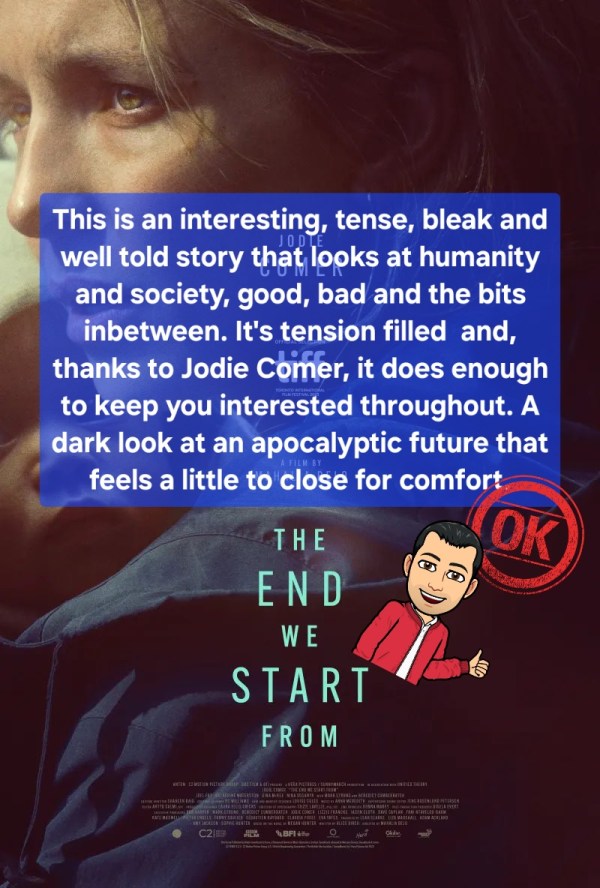
The End We Start From

Director: Mahalia Belo

Writers: Alice Birch, Megan Hunter

A young couple (Jodie Comer, Joel Fry) find themselves new parents in the middle of a developing environmental crisis. As flood waters starts to make London uninhabitable, they head off to high ground and his parents (Nina Sosanya, Mark Strong). But as the disaster continues resources become scarce and a life changing incident send the young parents back out into a very different world. We follow a young mother trying to navigate societal breakdown and an evermore treacherous landscape as she tries to find her way home, the life she’s lost and to give her new child a chance of a normal upbringing.

There is no getting away from this being a bleak look at a future impacted by environmental change. It’s close enough to reality to feel believable, uncomfortable and possible. It spends a lot of time in grey wind swept wilderness and sometimes it does make watching feel windswept, grey and hard work.

But it’s also interesting and in the, as always, excellent Jodie Comer, you have a lead who you engage with and care for as you feel every bit of her struggle as she tries to navigate a new world and new motherhood.

It’s a though story, but alongside Comer’s excellent performance full of strength and vulnerability, there is a host of solid performances that keep you involved and intrigued. This is especially true of Katherine Waterston who provides a companion for much of the journey. But it is Comer that does all the heavy lifting from start to finish.

It doesn’t work perfectly, it does feel it drags a little, but maybe that’s just the work involved navigating its endless bleakness.

This is an interesting, tense, bleak and well told story that looks at humanity and society, good, bad and the bits inbetween. It’s tension filled and, thanks to Jodie Comer, it does enough to keep you interested throughout. A dark look at an apocalyptic future that feels a little to close for comfort.
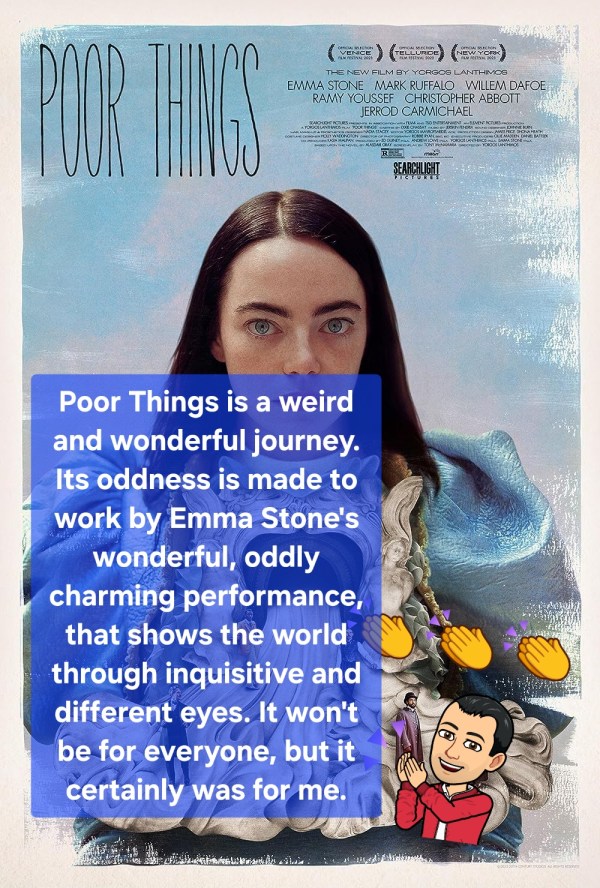
Poor Things

Director: Yorgos Lanthimos

Writer: Tony McNamara based on Alasdair Gray’s book.

Bella Baxter (Emma Stone) is, in Frankenstein style, the reanimated creation of the experimental Dr. Godwin Baxter (Willem Dafoe). Having found Bella’s body in the Thames he brings her back too life with a child’s brain. Studied by Baxter’s student Max McCandles (Ramy Youssef) Bella matures quickly, becoming increasingly curious of the world around her and of her sexuality. Her world changes when she meets Duncan Wedderburn (Mark Ruffalo) who seduces her with the chance to see the world. As Bella experiences more, her views change as she learns about its wonders and harsh realities. She outgrows Wedderburn as she strives to improve herself and her world, which brings her back to London, where she tackles mortality and her past.

This is a wild, often dark, often funny bit of storytelling. It is likely to be divisive and won’t work for some but it did for me.

It is carried by Stone’s fabulous performance which takes Bella from blank canvas to independent and driven. The character quirks remain, although less obvious as she grows. She portrays Bella’s quizzical distance as she continues to learn and remain confused by society but not one to accept the norms of others. It’s full of humour, heart and a strange charm.

There’s excellent support from Dafoe particularly, who’s misguided mad scientist, is built on its own dark story. Ruffalo is fun as he channels his 1950’s cinema cad through to is broken by a failure to find a way to control Bella. Both standout but it’s full of fine performances.

It looks gorgeous, part fantasy horror, part colourful stylised artwork. Accompanied by a score that matches its weirdness.

It’s not perfect. It outstays its welcome at times and has a final act that feels a little tacked, not really adding to Bella’s journey.

Poor Things is a weird and wonderful journey. Its oddness is made to work by Emma Stone’s wonderful, oddly charming performance, that shows the world through inquisitive and different eyes. It won’t be for everyone, but it certainly was for me.

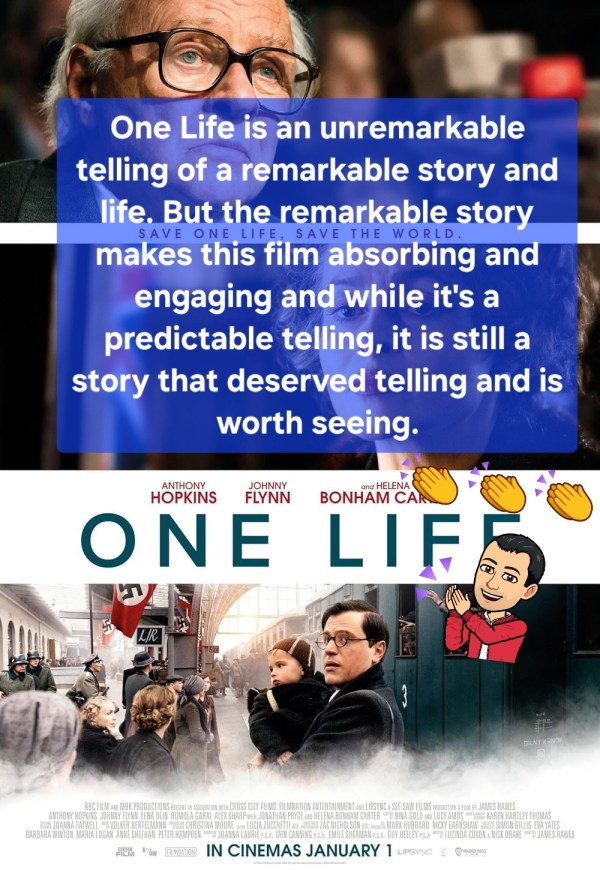
One Life

Director: James Hawes

Writers: Lucinda Coxon, Nick Drake

One Life tells the incredible story of Nicolas Winton, who finds in 1938 Prague the shocking reality of, mainly Jewish, families, displaced by the Nazi annexing of the Sudetenland. He finds them living in poverty and fear of their lives and is compelled to act. He does so by arranging the passage of over 600 children to England and safety. The story is told in two parts, young Winton (Jonny Flynn) in Prague, battling to arrange the transportation of 100’s of children to the UK. We also see an older Winton (Anthony Hopkins) looking back on his life, burdened by whether he could have done more, helped more, saved more lives. The film tells an important story of a remarkable man who never fully appreciates the lives he’s touched, until he finds it laid before him.

With stories as remarkable as this, sometimes they only need putting on screen to be engaging and interesting and One Life is an example of that. An unremarkable telling of a truly remarkable story.

The films unremarkable nature doesn’t really matter as the subject matter ensures the film always keeps your attention. However, it’s a bit formulaic and a lot of surface rather than depth. The story is full of characters who did incredible things, took huge risks, tackled bureaucracy and impacted thousands of lives, but it never really feels that it fully explores that. It is more successful looking at Winton’s later life, Anthony Hopkins portraying a humble man, carrying memories and guilt for those who couldn’t save. And the films touching climax is emotionally well delivered.

Flynn and Hopkins potray the two parts of Winton’s life well, they are well supported, particularly Helena Bonham Carter’s portrayal of Winton’s strong and driven mother. However, she is almost the only supporting character who gets much to do.

One Life is an unremarkable telling of a remarkable story and life. But the remarkable story makes this film absorbing and engaging and while it’s a predictable telling, it is still a story that deserved telling and is worth seeing.

Next Goal Wins (2023)

  • Available: Cinema
  • Director: Taika Waititi
  • Writers: Taika Waititi & Iain Morris

Next Goal Wins, based on the 2014 documentary, is a comedic dramatisation the story of the American Samoa football teams attempts to improve from a world record 31-0 defeat. Experienced coach Thomas Rongen (Michael Fassbender) is brought to the island by ambitious local F.A. head Tavita (Oscar Kightley) with one goal, to score one goal in a qualifying match. Can Rongen bring together this rag tag team to win, while tackling his own demons?

Having seen this, I’m a little surprised by the sniffy reviews it has received, personally, I think Waititi has created a heartwarming, light hearted under dog story, using the true story as a rough outline. If you want to understand the true story the 2014 documentary is the place to look, not this. But if you want an enjoyable and engaging dramatisation of it, this could be for you.

Some of your enjoyment may well come down to how you feel about Waititi’s comedy, but that aside, this is a good hearted under dog story. It is full of sports story tropes, the flawed coach on his last chance. The rag tag no hopers and the feel good bringing them together into a team. But there is more to it, some thoughtful pieces around heritage and acceptance, fun with the white saviour narrative and a fascinating insight into trans gender acceptance in Jaiyah’s (Kaimana) story, a treatment that may a nation could learn from.

The story is formulaic and takes liberties with the true story. but it is funny throughout and touching at times. Performances are solid with Fassbender showing his comic touch, well supported by Kightley particularly but there are no missed steps from the cast.

What it does do surprisingly well is the football recreations, believable throughout even with the occasional comedic stretch!

While Waititi’s comedy may not be for everyone and some sniffy reviews confirm that. For me Next Goal Wins is a fun, uplifting occasionally touching feel good film and put an end of year smile on my face.

Maestro

  • Available: Netflix
  • Director: Bradley Cooper
  • Writers: Bradley Cooper, Josh Singer

Maestro looks at the life of U.S. composer, musician and conductor Leonard Bernstein (Bradley Cooper). More specifically it focuses on his long time marriage and realtionship with Felicia Montealegre (Carey Mulligan) spanning over 30 years. It examines the complexity of the realtionship caused by their work, Bernstein’s sexuality and ultimately health.

This is another in a recent series of biographical dramas that didn’t really hit the spot for me. How much it captures of Bernstein, I don’t know enough about him to be sure, but then that’s part of the problem, I never really felt that I got to know enough about him to care about this dramatised version of him.

Bernstein was clearly talented and had a complex life, with fluid sexuality and an inner battle between composer and conductor, but little of that comes through. It is a more successful with the realtionship with Felicia and while she fully understands the man that he is, over time it takes its toll, but even that never engaged me enough to be fully absorbed by it. The film is at its best as it deals with the final months of Felicia’s life as she is ravaged by illness, it shows, for all its complexity a touching and loving relationship.

The film does look good, especially its first part shot in black and white with a 50’s drama feel, that moves through his life, at times, like a musical. The music of course works well with Bernstein’s back catalogue on show. And Cooper and Mulligan are solid in the two main roles, but it is only these two with no other characters given any depth.

It also feels long and slow as it meanders between parts of his story that are never really clear as to how important they are.

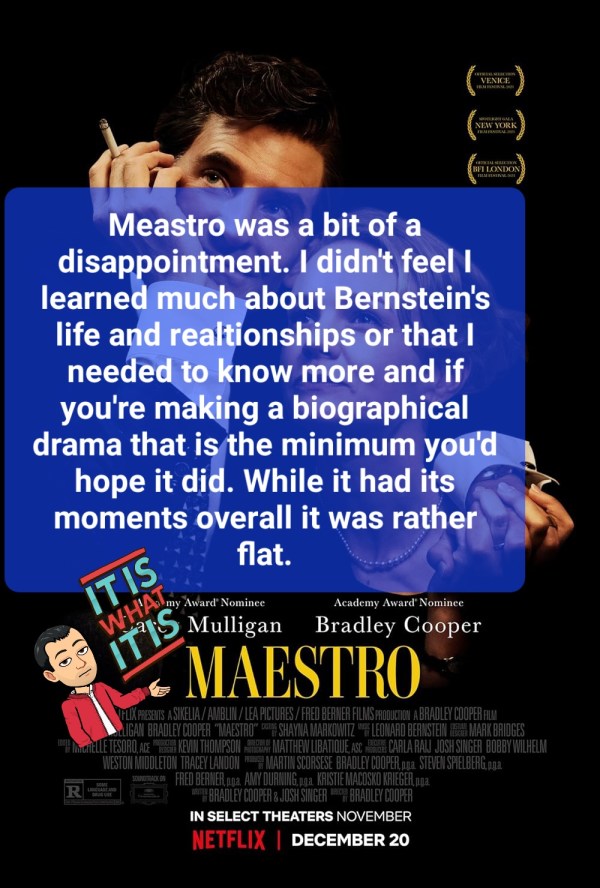
Meastro was a bit of a disappointment. I didn’t feel I learned much about Bernstein’s life and realtionships or that I needed to know more and if you’re making a biographical drama that is the minimum you’d hope it did. While it had its moments overall it was rather flat.

Ferrari

  • Directed by Michael Mann
  • Written by Troy Kennedy Martin based on Brock Yates book.

Set in 1957 the film follows Enzo Ferrari through the toughest year of his life. His business is on the edge of failure as is his marriage to Laura (Penélope Cruz). Both struggling to come to terms with the loss of their son. Enzo is hiding a second family with Lina Lardi (Shailene Woodley) and their son Piero. Alongside this Ferrari face a make or break race at the upcoming Mille Miglia. A win will raise Ferrari’s profile and order book, while defeat will see its end. But it is a race that will come with the very highest price.

This is a film that should work, a story about a sporting icon, when his sport was at its most glamorous as racers won hearts with their exploits in the face of huge danger. But none of that made it to the screen. I’m not sure whether Ferrari’s life wasn’t interesting enough to carry the story, or whether it was the paper thin characters who I struggled to connect with, but it didn’t do it for me.

It all felt disjointed with a lack of chemistry between characters. Ferrari and Lardi’s affair felt cold. Drivers who were putting their lives on the line were never developed enough to care about them as inevitable disaster closed in. It was very formulaic with every twist and turn clearly signposted

It wasn’t terrible and that’s in no small part due to Cruz who brings much needed energy to the screen portraying a smart, passionate and quick-witted Laura. Her exchanges with Driver, who is as dependable as ever, are the only time the film comes to life.

Its other plus is the recreation of the races, some shonky CGI aside, which put you in the heart of the action giving you a feel of the bone rattling speeds and risks the drivers were taken. Its just a pity that the film gave them so little substance to care about.

Ferrari felt a little cold and dull, some excellently recreated races and Penélope Cruz aside. Whether it is the source material or the adaptation I don’t know, but it just never really grabbed me. More beige family car than Ferrari.

Godzilla Minus One

Takashi Yamazaki brings us this latest Godzilla incarnation. Set in Japan, at the end of the second world war, we find Kōich (Ryunosuke Kamiki) a Kamakaze pilot, forced to ground his plane at a small aircraft base. It is here he first witnesses the terrifying power of Godzilla. He survives and returns to a Tokyo decimated by war, where he meets a young woman Noriko (Minami Hamabe) and the small child she is caring for. Together they, as the country does, try to rebuild their lives. But when Kōich finds himself working as a minesweeper he also finds himself on course to meet Godzilla again. A creature focussed on destruction and with no government or army to help. The people must tackle the terrifying monster themselves.

In a world of CGI filled monster movies, this was a hugely enjoyable and refreshing change. As a fully Japanese production (which includes it being in Japanese with subtitles) it’s an evocative throwback to all that has gone before. A modern B-movie in all the best ways.

While Its story is built around a battle with a monster, it is much more about its people, people damaged by war, wracked with thoughts of guilt and failure. This is particularly true for Kōich who feels a coward, suffers from PTSD and for him he’s fighting a war that hasn’t ended. Alongside this is it also intelligently explores post war Japan asking questions of it and its war time attitude to its people.

Its recreation of classic Godzilla works really well. Its slow massive emotionless plodding monster . Its B-Movies plot and “on the nose dialogue”. Its fantastic score and sound design, that includes a use of silence that Christopher Nolan would be proud of, this is a fabulous reminder of a bygone era. All done for just $15M

Godzilla Minus One is a wonderfully enjoyable evocative monster movie, far removed from the crash and bash nonsense we are used to. Its look, its brilliant sound and story keep you hooked from first monstrous step to the last. A film with a lot to enjoy. And I enjoyed a lot.

Leave the World Behind

New to Netflix, Sam Esmail brings his adaptation of Rumaan Alam’s novel. Having had enough of the day to day of her life Amanda (Julia Roberts) decides to book a luxury home for a short getaway with her husband Clay (Ethan Hawke) and her children. The house and the sleepy town it’s part of are perfect. But then a trip to the beach starts a series of events that change everything first an oil tanker runs aground on the beach, then Internet and TV fail. Finally two visitors arrive George (Mahershala Ali) and his daughter Ruth (Myha’la) claiming to be the owners of the house, forced to return to their home after a blackout in the City. There’s distrust on both sides and increasing frustration and desperation as it becomes clear that this is more than just a blackout.

This is an enjoyable tense psychological thriller. Which plays on the impact of been disconnected from society, the lack of information and of conspiracy. It also smartly uses the biggest of contemporary threats that of cyber attacks to critical infrastructure. And how a breakdown in infrastructure can lead to societal breakdown.

It’s also a film about people, prejudice, trust and the balance of helping others versus protecting your nearest and dearest.

The performances are what you’d expect from a stellar cast. Julia Roberts is great as are Ali and Hawke. Alongside them is an excellent performance from Myha’la as the suspicious, snarky, daughter who goes up against Robert’s world weary mother.

It’s well written, performed and shot, all of which is used to engage you in the unease and disorientation of those on screen, keeping you on edge.

If there is a criticism, it is this it is overly long (138m) which means it does drag occasionally. The ending may also be a little divisive.

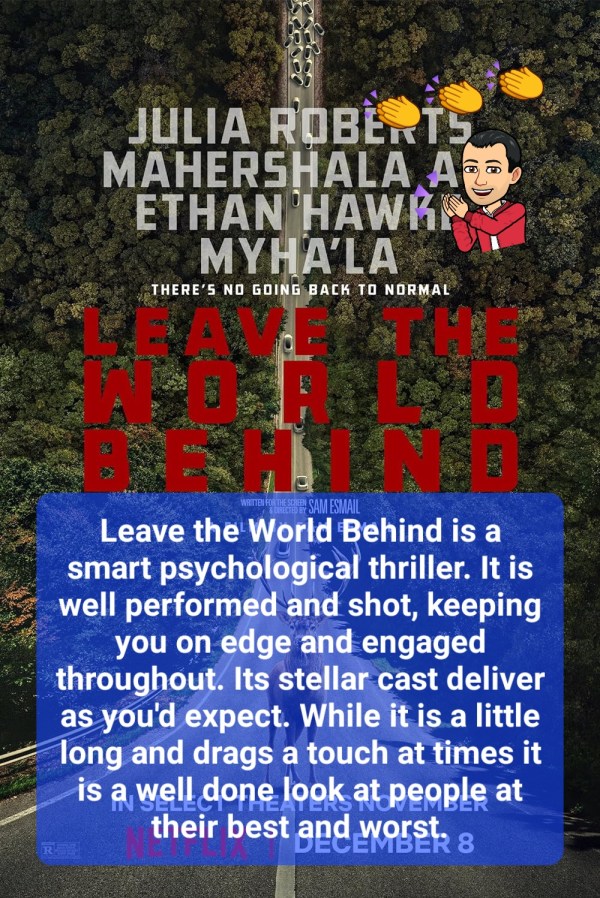
Leave the World Behind is a smart psychological thriller. It is well performed and shot, keeping you on edge and engaged throughout. Its stellar cast deliver as you’d expect. While it is a little long and drags a touch at times it is a well done look at people at their best and worst.

Wonka

Paul King and Simon Farnaby, the team behind the excellent Paddington films, created an origin story for Roald Dahl’s chocolate making genius Willy Wonka. We find Wonka (Timothée Chalamet) returning from 7 years of voyaging around the world and heading for the home of the world’s finest chocolatiers to introduce his chocolates and make his fortune. When the public love his incredible sweets he finds himself in the sights of the chocolate cartel of Slugworth, Fickelgruber and Prodnose and imprisoned in the laundry of Scrubbit (Olivia Colman) and Bleacher (Tom Davis). But with the help of a young girl Noodle (Calah Lane), the other laundry prisoners and his orange Oompa Lumpa nemesis (Hugh Grant), Wonka develops a plan to end the cartel and bring his fantastic chocolate to the world.

Wonka has things to enjoy. It’s colorful, fun, has a dark Dickensian feel with snappy song and dance numbers. But, I wanted to love it much more than I did.

It’s by no means terrible, Colman and Davis are excellent as the Dickensian laundry owners as is Grant’s Oompa Lumpa. Paterson Joseph. Matt Lucas and Matthew Baynton are great as the suitably Dahlesque chocolate cartel and Keegan-Micheal Key’s police chief is equally classic Dahl. Chalamet and Calah Lane are the heart of the film and it is often at its best when they are together. There are lovely links to Gene Wilder’s 1972 classic, with nods to his future factory, his cane that stands on its own and a beautiful use of the classic Pure Imagination. All of this in a story that feels like Dahl and does not feel out of place in the world of Wonka.

All of that said, it doesn’t all quite work. It doesn’t quite engage as you’d hope and lacks the charm of the 1972 version. It also lacks the heart of the makers Paddington films.

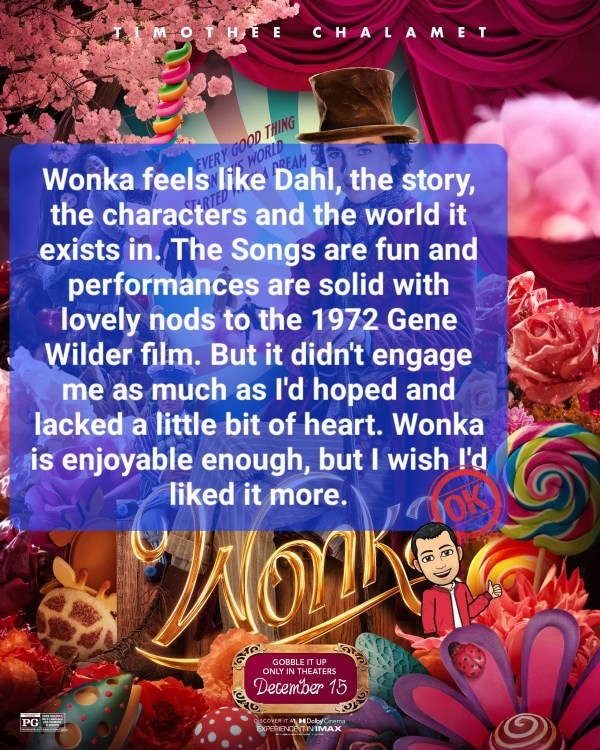
Wonka feels like Dahl, the story, the characters and the world it exists in. The Songs are fun and performances are solid with lovely nods to the 1972 Gene Wilder film. But it didn’t engage me as much as I’d hoped and lacked a little bit of heart. Wonka is enjoyable enough, but I wish I’d liked it more.

Eileen

Directed by William Oldroyd and written by Luke Goebel and Ottessa Moshfegh whose novel the film is also based on. Eileen (Thomasin McKenzie) is a young woman working on the local prison and daughter to an alcoholic father, unappreciated at work and disrespected at home. However her life changes when a new psychiatrist is appointed at the prison. Rebecca (Anne Hathaway) is Harvard trained, confident, smart and go Eileen mysterious and alluring. However, when Rebecca takes interest in the case of Lee Polk it takes Eileen and Rebecca on an unexpected journey that changes everything for Eileen.

Eileen is a dark and intriguing piece of storytelling, that while it didn’t completely work for me, it did plenty that kept me absorbed throughout, possibly helped by its 97 minutes run time.

It’s built on two strong lead performances. Anne Hathaway’s strong, confident Rebecca and especially Thomasin McKenzie in the title role, who appears vulnerable and unsure on the surface, but beneath that is a determined women who wants more. It is the alluring Rebecca who attracts Eileen and gives her the confidence to change, although not in the way Rebecca expects.

They are well supported especially by Shea Whigham as Eileen’s drunk and oppressive father and Marin Ireland, who plays Lee Polk’s mother.and delivers an incredibly powerful telling of the story of her son and husbands murder.

The story is dark in tone and it’s subject matter and while it is a touch predictable, the journey takes a few surprising turns. However, it does get a little lost in its own complexity, sometimes feeling muddled and confusing.

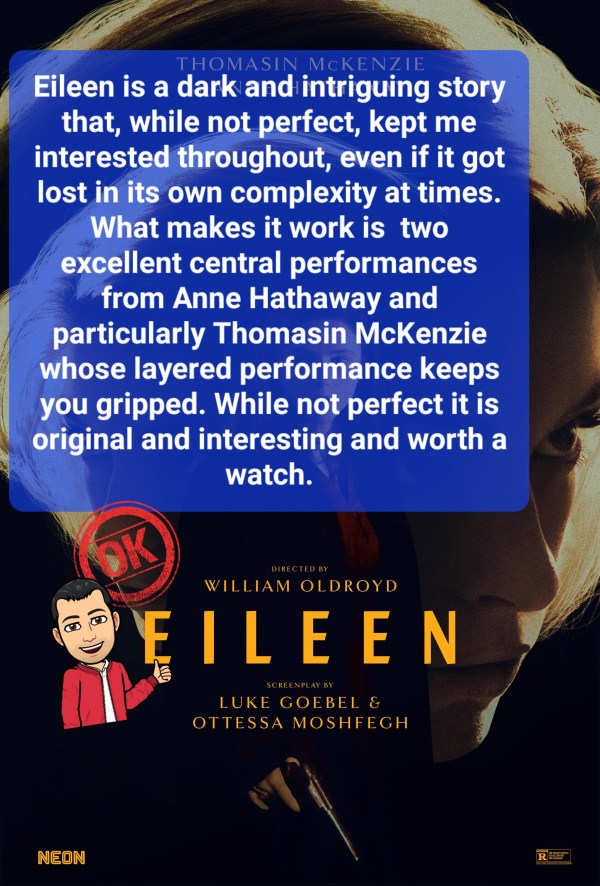
Eileen is a dark and intriguing story that, while not perfect, kept me interested throughout, even if it got lost in its own complexity at times. What makes it work is two excellent central performances from Anne Hathaway and particularly Thomasin McKenzie whose layered performance keeps you gripped. While not perfect it is original and interesting and worth a watch.

Blog at WordPress.com.

Up ↑

Design a site like this with WordPress.com
Get started