The Brutalist

Writer/Director: Brady Corbet

Writer: Mona Fastvold

László Tóth is a Jewish immigrant, who having escaped his home country arrives in 1947 United States. He’s a talented well respected architect. But now finds himself alone, separated from his wife (Felicity Jones) and adopted daughter (Raffey Cassidy). His life in America changes when he meets the wealthy Harrison Lee Van Buren (Guy Pearce), who asks László to build a centre to memorialise his late mother. We follow his story, of building his epic masterpiece and all that happens during it.

The Brutalist is as angular, beautiful and impressive as one of László’s great structures.

It’s easy to talk about its epic scale, cinematography and pounding score. Or the fine performances, Adrian Brody is compelling and strongly supported by Pearce, Felicity Jones and Isaach de Bankolé, with an entire cast that is note perfect.

But what makes The Brutalist work is the depth of its story. It’s about the desperation of the displaced and the immigrant experience. It deals with power dynamics, as the powerful play out their follies on the backs of others, pulling dreams away on a whim. It is distinctly in two parts, before and after its intermission. The first, more hopeful about building a life, chasing a dream. The second starts beautifully, but is darker as the reality of the control of the powerful, bites deep. While the second half takes a few stranger turns, it is in its epilogue that is perhaps its most powerful moment, as László’s motive behind his work becomes clear and how he used his art to show defiance.

It is a film to admire, a sweeping cinematic experience, telling an epic powerful story.

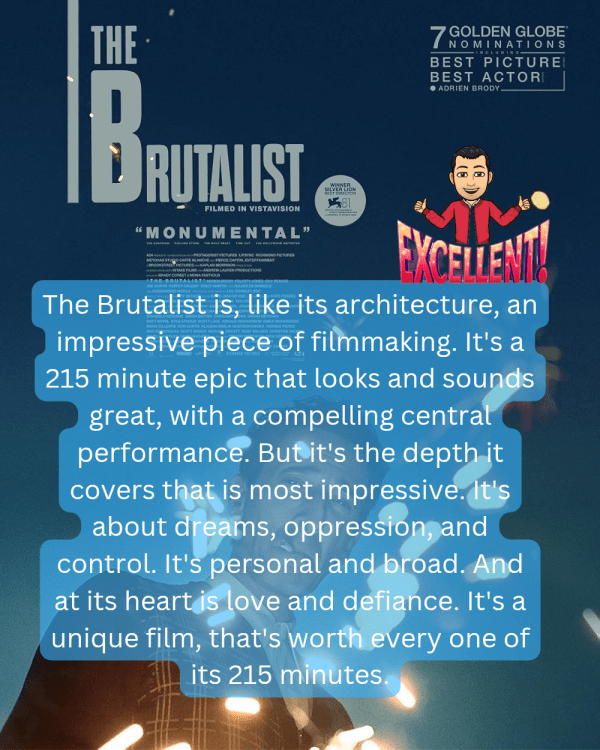
The Brutalist is, like its architecture, an impressive piece of filmmaking. It’s a 215 minute epic that looks and sounds great, with a compelling central performance. But it’s the depth it covers that is most impressive. It’s about dreams, oppression, and control. It’s personal and broad. And at its heart is love and defiance. It’s a unique film, that’s worth every one of its 215 minutes.
A Real Pain

Writer/Director: Jesse Eisenberg

After the recent death of their grandmother, David and Benji (Jesse Eisenberg & Kieran Culkin) head on a road trip to Poland to join a Jewish history tour and better understand their grandmother’s homeland and heritage. The boys are very different, leading to a trip where they make some tough discoveries about their heritage and relationship.

A Real Pain is not particularly original it’s a traditional road movie, with two very different people, who have grown apart. But the reason the structure keeps getting used is, when done well, it works very well. A Real Pain does the road movie very well, it’s funny when it should be, melancholic when it has to be, uncomfortable at times, touching and a film full of heart.

It is built around the often strained relationship between David and Benji. David the married man with a child and a stable job, while Benji remains the free spirit who wears his heart on his sleeve, speaking without a filter. But both of them hide hurt and worry. And in Rosenberg and Culkin you have two perfectly cast performers who are believable and relatable, bringing humour, pathos and heart.

The two are well supported in the form of the tour group they meet in Poland with Will Sharpe, Jennifer Grey, Kurt Egyiawan, Liza Sadovy and Daniel Oreskes all used by the main characters to, in different ways, show difference and explore feelings and hurt. Each performance balanced just right.

The film is very well judged, none more so in its scenes at a concentration camp. Where it captures the poignancy of these horrific sites perfectly. With a thoughtful cinematic eye and gentle pace.

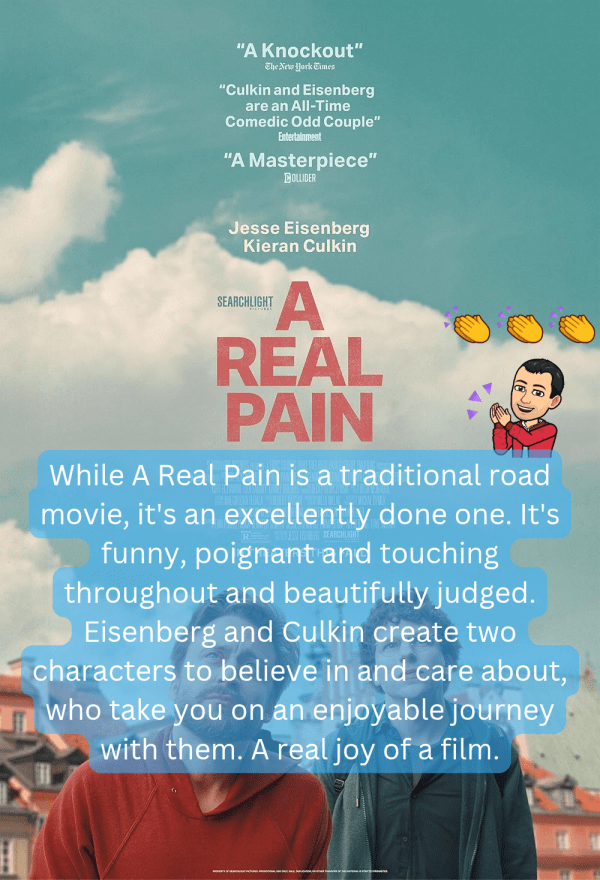
While A Real Pain is a traditional road movie, it’s an excellently done one. It’s funny, poignant and touching throughout and beautifully judged. Eisenberg and Culkin create two characters to believe in and care about, who take you on an enjoyable journey. A real joy of a film.

A Complete Unknown

Writer & Director: James Mangold

Writer: Jay Cocks

A Complete Unknown follows the early days of the career of the musical legend that is Bob Dylan (Timothée Chalamet). It starts in 1961 and his meeting  Woody Guthrie (Scoot McNairy) and Pete Seeger (Ed Norton). It follows Dylan’s journey from struggling musician, to star, via his relationships with Joan Baez (Monica Barbaro) and Sylvie Russo (Elle Fanning), the creation of his classic music and his run-ins with the “traditional” folk music scene. Concluding in his appearance at the 1965 Newport Folk Festival.

While I enjoyed this, for the awards buzz around it, it was a pretty pedestrian nuts and bolts biopic. It never does any more than takes a surface look at Dylan’s early career and relationships. The story beats seem no more than a time filler between recreations of Dylan’s music, rather than a chance to learn more about the man and his life.

Which is a pity, as the story let’s down Chalamet’s committed performance, turning it into a set of impressions of key Dylan performances. The supporting cast have mixed amounts to work with, Ed Norton perhaps has the most, but Elle Fanning and Monica Barbaro are both underused and under-explored. Scoot McNairy does manage to do a touching turn as a seriously ill Woody Guthrie.

But it’s this lack of depth in the story that leaves it all as no more than a celebration of Dylan’s work, rather than any kind of detailed look at the man and what drives him. While Chalamet delivers a performance that captures the “tortured genius”, the film also fails to really explore how that impacts those around him either.

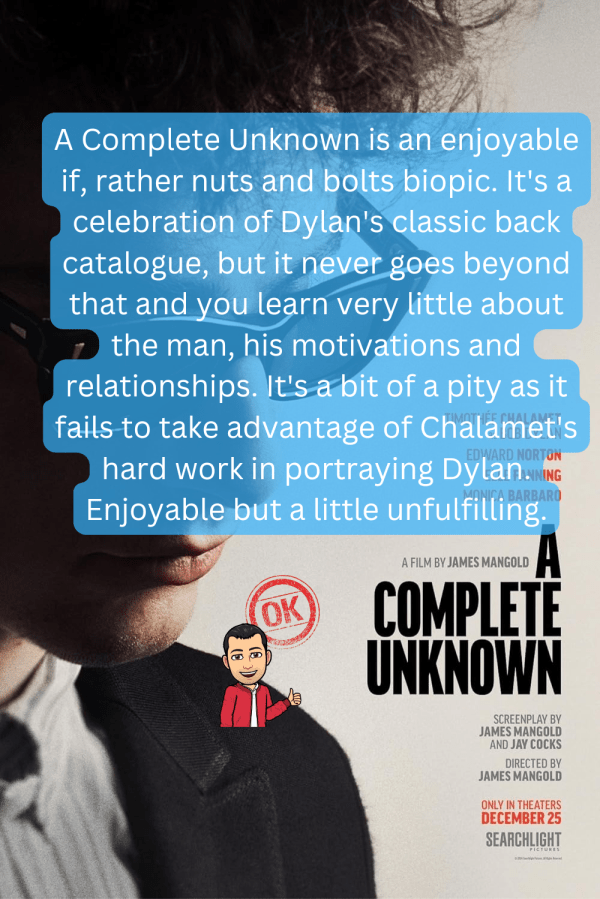
A Complete Unknown is an enjoyable if, rather nuts and bolts biopic. It’s a celebration of Dylan’s classic back catalogue, but it never goes beyond that and you learn very little about the man, his motivations and relationships. It’s a bit of a pity as it fails to take advantage of Chalamet’s hard work in portraying Dylan. Enjoyable but a little unfulfilling.

Maria

Director: Pablo Larraín

Writer: Steven Knight

Maria is set in the final week of the life of legendary opera singer Maria Callas (Angelina Jolie). The story is set around Callas trying to come to terms with a body and, most crushingly, voice that is failing her. Trying to build her voice, so she can sing again, she does so while reflecting on her life, her childhood relationship with her mother and her relationship with Aristotle Onassis (Haluk Bilginer). All while coming to terms with her fading fame.

Maria is a melancholic, humourous, often tragic, but beautifully told story. It is helped by being set against the equally melancholic, beauty and power of opera.

It’s at its best when we focus on Callas and her struggles to come to terms with her fallibility. Told partly in flash back and more interestingly by her conversations with a film maker Mandrax (Kodi Smit-McPhee), a construct of Callas’s imagination. The strongest parts are here and in the relationship she has with her loyal staff, Farruccio (Pierfrancesco Favino) and Bruna (Alba Rohrwacher). Relationships that portray love, loyalty and anguish as those closest to her see all her frailty.

It revolves around Angelina Jolie’s excellent performance. Carrying off the balance between the elegant diva and broken and vulnerable older Callas perfectly.

The film looks great presenting the different eras in styles evocative of the filmmaking of that time. And of course it sounds great, blending Jolie’s vocals with the power of Callas’s real voice.

It only really falters when time is spent on her relationship with Onassis, which while important feels an unnecessary diversion, from the film’s strengths.

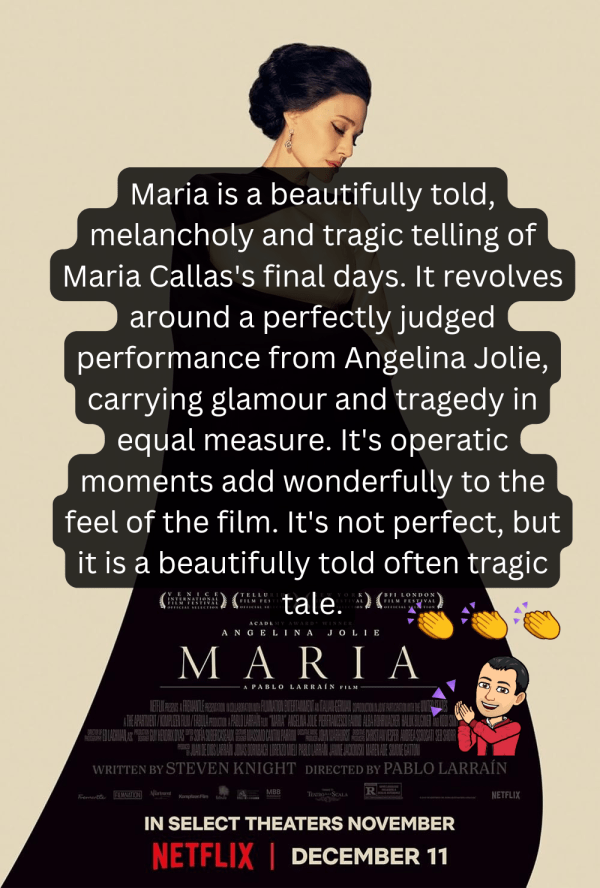
Maria is a beautifully told, melancholy and tragic telling of Maria Callas’s final days. It revolves around a perfectly judged performance from Angelina Jolie, carrying glamour and tragedy in equal measure. It’s operatic moments add wonderfully to the feel of the film. It’s not perfect, but it is a beautifully told often tragic tale.

We Live in Time

Director: John Crowley

Writer: Nick Payne

We Live in Time, follows the life of talented chef Almut (Florence Pugh) and data analyst partner Tobias (Andrew Garfield). It tells the story of their lives together from the first, painful meeting, through all of their relationship ups and downs. We see them juggle careers, different ambitions, family and most tellingly, the difficulties that come with challenging health problems. All through a series of vignettes, that capture their lives through its emotional, humourous and hard moments.

We Live in Time, is a film that doesn’t completely work, but has enough in it to keep you engaged. What most definitely works is its two stars, who, overcome the challenges the storytelling choices present, by being believable and engaging.

Florence Pugh’s Almut, takes you on a demanding journey, a driven and talented young woman, whose life is turned upside down by the hardest of health diagnosis. Her performance always demands your attention as she struggles with how to live a life and make an impact. Garfield is the right balance against Pugh’s powerhouse performance, a calm and quiet presence around which the story revolves. Together they are believable and very watchable.

What worked less well was the non linear storytelling, which, by using moments, means you never quite feel involved, a bit like watching a highlights reel. It is also very Almut centric, it feels like Tobias is merely a spectator, it never feels like we understand the true impact of Almut’s health on his or anyone else’s life. The story is such a powerful one, but those choices means you never quite feel fully drawn in and because of it its emotional climax falls a bit flat.

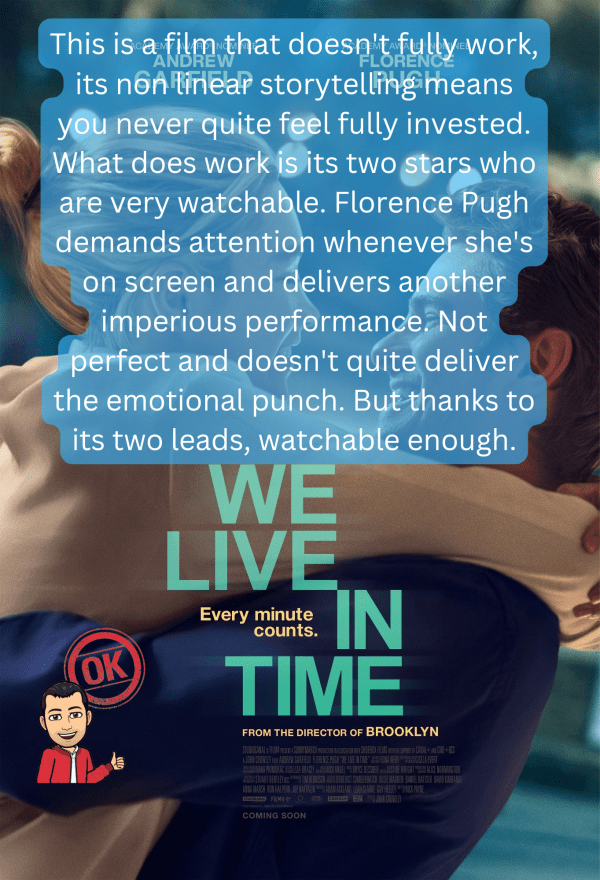
This is a film that doesn’t fully work, its non linear storytelling means you never quite feel fully invested. What does work is its two stars who are very watchable. Florence Pugh demands attention whenever she’s on screen and delivers another imperious performance. Not perfect and doesn’t quite deliver the emotional punch. But thanks to its two leads, watchable enough.

Nosferatu

Writer/Director: Robert Eggers

Newly married Thomas (Nicholas Hoult), is asked by his new boss Herr Knock, (Simon McBurney) to travel to Transylvania to meet with the mysterious Count Orlok (Bill Skarsgård) and sign the deeds on a new property. His new wife Ellen (Lily-Rose Depp) is panicked by the trip. Haunted by dark visions since her youth, she is terrified of the risk Thomas faces. Her fears are not misplaced, as Thomas finds a dark, foreboding castle and Count. The journey has not only placed him at risk, but also all of those back home. Thomas and Ellen, with help from Frederick (Aaron Taylor-Johnson), Dr. Sievers (Ralph Ineson) and Prof. Von Franz (Willem Defoe) must tackle the risk Orlok poses and save those he threatens.

This is a wonderfully dark, melodramatic, camp, gothic horror.

It is built around the obsession between Ellen and Orlok, their fates intertwined in ways they do not realise. And also.against a fear of the unknown, driven by superstition, but also the more contemporary fear of an unknown plague, sweeping through the land.

The story telling is wonderfully gothic. It is often melodramatic in a way only gothic horror can be. It is tense and dark, creating an unease and fear that is wholly absorbing. And when it needs to, it produces bloodlust and gore.

It is built around its two central performances. firstly Skarsgård’s Orlok, who thrives in the shadows. But it’s  Lily-Rose Depp that steals the show. Seen as nothing more than a girl haunted by her melancholy, she grows as she realises the responsibility and part she plays. Delivered with a fabulous physical performance.

It is beautifully shot and blends colour and monochrome seamlessly to show the shadow Orlok casts. It’s dark streets, high towers and imposing buildings, a masterclass in gothic horror.

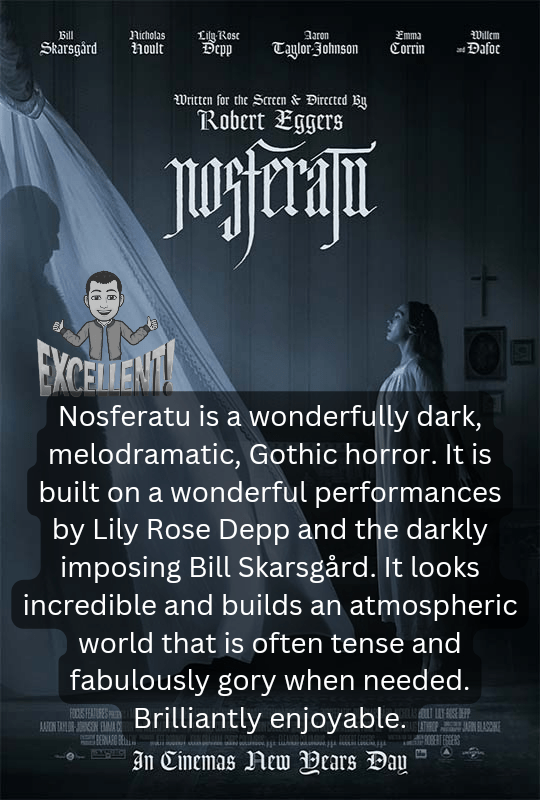
Nosferatu is a wonderfully dark, melodramatic, Gothic horror. It is built on a wonderful performances by Lily Rose Depp and the darkly imposing Bill Skarsgård. It looks incredible and builds an atmospheric world that is often tense and fabulously gory when needed. Brilliantly enjoyable.

Mufasa: The Lion King

Director: Barry Jenkins

Screenplay: Jeff Nathanson

As Simba (Donald Glover) and Nala (Beyoncé) head off, they leave young Ciara (Blue Ivy Carter) in the care of Timon, Pumba and wise old mandrill, Rafiki (Billy Eichner, Seth Rogan, John Kani). To pass the time on a dark wet night. Rafiki tells the story of Ciara’s grandfather, Mufasa and how he became king. The story follows Mufasa from a young cub, through to the adolescent lion who becomes king. Along the way he meets the key people in his life, which includes Taka (Kelvin Harrison Jr.) and Sarabi (Tiffany Boone) and also the incidents that define his future.

Whether the world needed a Lion King origin story is questionable and now we have one, it probably still is. It’s by no means a terrible film, but it’s also no more than okay.

One of the challenges with origin stories is that the end is already defined, it’s just a matter of how you get there and can you make that journey interesting. That’s what Mufasa just about gets away with.

The story is a traditional journey of discovery. Discovery of a new home and of course discovery about each other, all wrapped up with some big Disney musical numbers and some classic Disney movie peril. But the story is also long and does come with plenty of lions talking! This gives it a bit of a pacing problem as it does on occasion drag.

It looks great, with the impressive photo realistic animation. Lin Manuel Miranda’s songs work well and the voice cast is solid enough.

To be clear, I realise this is not a film aimed at me and there is probably plenty for a younger audience, but it all does feel a little safe and “adequate” all a bit meh!

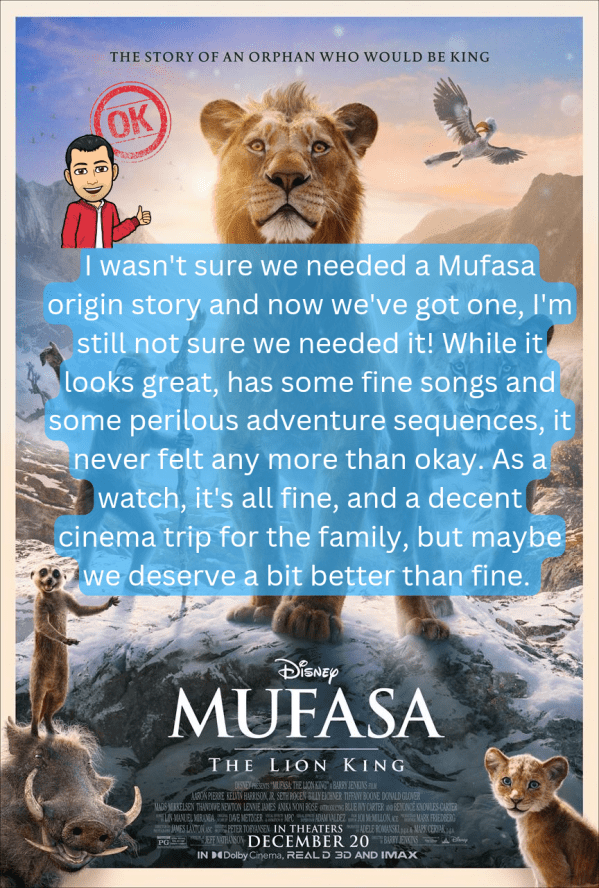
I wasn’t sure we needed a Mufasa origin story and now we’ve got one, I’m still not sure we needed it! While it looks great, has some fine songs and some perilous adventure sequences, it never felt any more than okay. As a watch, it’s all fine, and a decent cinema trip for the family, but maybe we deserve a bit better than fine.

Better Man

Director/Writer:Michael Gracey

Writers: Oliver Cole & Michael Gracey

Better Man tells the, often complicated, life story of Robbie Williams. Portrayed throughout as a CGI chimpanzee (motion captured by Jonno Davies), rather than lookalike actor, the story goes from childhood, through his, successes, failures and his battles with the many demons that have haunted him. All backed with Williams’s own crowd pleasing back catalogue.

Better Man takes a creative approach to telling Williams’s story, presenting him as a chimpanzee and telling some of the story’s darker moments in a kaleidescope of fantasy images. But it uses its creativity well, offering a thoughtful, humourous, warm hearted and touching look at Williams life, offering one of the most enjoyable cinematic trips of the year.

At the centre of what makes it work is presenting Williams as a chimp. Rather than being a gimmick, it allows the film to tell its story and get under the skin of Williams, and you quickly forget he’s a chimp.

The story hits the beats you’d expect, Take That, the split, the solo career, the celebrity run-ins. But it is more than that, it’s a deep look into an often troubled person, thrust into the limelight at a young age. We see what shapes him, his relationship with his father (Steve Pemberton), his Nan (Alison Steadman), the rock who believes in him, and his put upon mother (Kate Mulvany).

We see his creativity and desire, his doubt and self loathing, and how this leads to self destructive behaviour. But it never looks for excuses, it feels like Williams wants to take responsibility not lay blame. All interspersed with Williams back catalogue presented as fabulous song and dance numbers and one of his best, Angels, used in a heartbreaking montage.

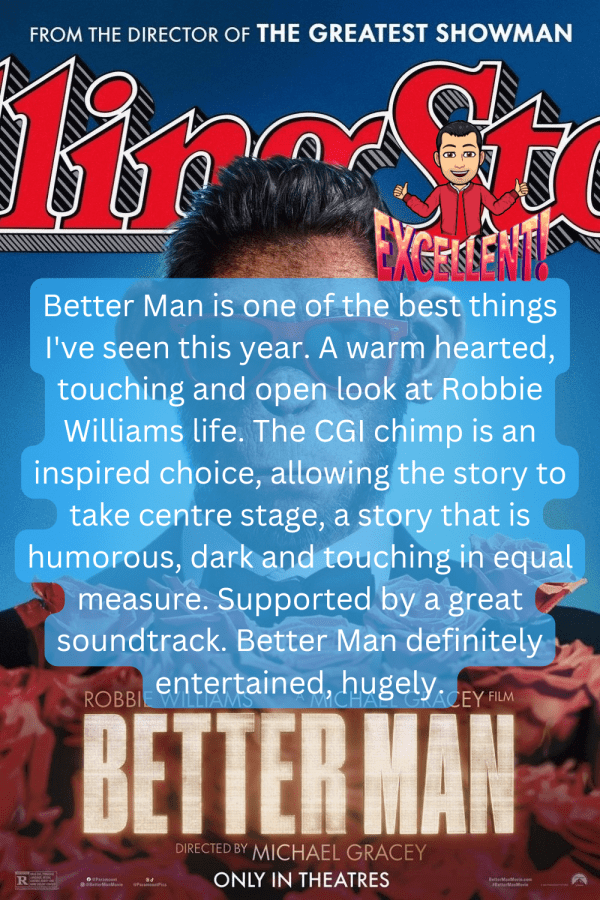
Better Man is one of the best things I’ve seen this year. A warm hearted, touching and open look at Robbie Williams life. The CGI chimp is an inspired choice, allowing the story to take centre stage, a story that is humorous, dark and touching in equal measure. Supported by a great soundtrack. Better Man definitely entertained, hugely.

Sonic the Hedgehog 3

Director: Jeff Fowler

Writers: Pat Casey & Josh Miller

It’s the third outing for everyone’s favourite blue hedgehog, Sonic (Ben Schwartz) and his friends Knuckles (Idris Elba) and Tails (Colleen O’Shaughnessey). Celebrations for Sonic’s arrival on earth are interrupted by  Director Rockwell (Krysten Ritter) who needs the gangs help to tackle a new menace, Shadow (Keanu Reeves). Shadow is set on revenge for his treatment and on destroying anyone who gets in his way. Sonic realising he needs helps, calls for support from an unexpected source, Dr. Robotnik (Jim Carrey). Together the group must not only deal with the threat Shadow poses to them, but to the whole planet!

The Sonic series have been good, fun, entertaining adventures. And this third encounter continues to deliver. From the start it is a fast paced, blur of colour, action and a smattering of gags.

The films plot is basic, but it comes with a good messages for its primary target audience. Messages around choices, dealing with loss and doing the right thing all delivered in a fun package. This includes Shadows thoughtful back story which deals with loss and how he chooses to deal with it.

The lead characters all deliver. Carrey perhaps has the most fun, especially when Robotnik meets his long lost Grandpa (also played by Carrey) to team up and hinder rather than help. Reeves also has fun with Shadow, as do the animators, placing Shadow in more than one John Wick looking scene.

At 1hr50 it probably runs a little long, but it’s colourful and action packed enough to get away with it.

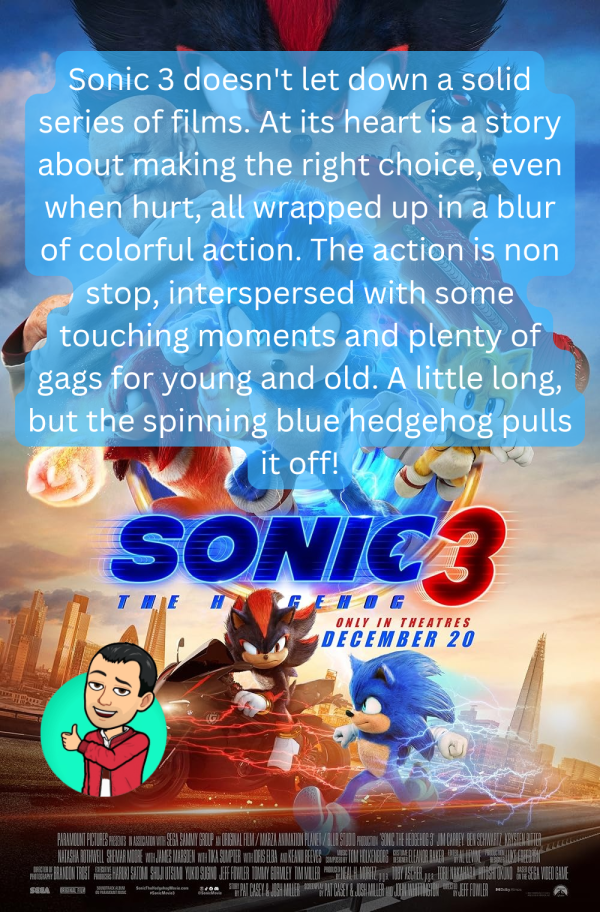
Sonic 3 doesn’t let down a solid series of films. At its heart is a story about making the right choice, even when hurt, all wrapped up in a blur of colorful action. The action is non stop, interspersed with some touching moments and plenty of gags for young and old. A little long, but the spinning blue hedgehog pulls it off!

Queer

Directed by: Luca Guadagnino

Screenplay by: Justin Kuritzkes based on the novel by William S. Burroughs

William Lee (Daniel Craig) is an expat American living in Mexico. A man of means, a dilettante, who spends his time in the city’s gay bars, looking for casual relationships, until he comes across a young American, Eugene Allerton (Drew Starkey). This quickly turns into infatuation, Lee becomes obsessed and desperate to understand Eugene and his feelings towards him. Eventually the two head off on a journey through South America, a journey that deals with Lee’s drug addiction, obsession with Allerton and their relationship.

I have a mixed relationship with Guadagnino’s films, some I’ve enjoyed, some I have disliked hugely. Queer sits somewhere in the middle. In its first two thirds, there are themes common to Guadagnino’s films, obsession and desire. It looks wonderful, and has some great needle drops. Then its final third goes on a psychedelic trip and it has to be a trip you’re prepared to go on, if you’re not, it’s likely it will all begin to feel a little self indulgent and tiresome.

It’s not without merit, especially in its performances, Craig is excellent as the unsure and obsessed Lee, a man unsure of who he is and, more importantly, how he is seen. Starkey is enigmatic, never giving away too much. Jason Schwartzman supports well, as does Lesley Manville, in a scene stealing performance as the jungle based botanist, Dr. Cotter.

But It is the final act that killed it for me. While the first two acts, may have been slow moving at times, the story was well told with a sweetness to it. But its drug induced trip in the final act lacked that and forced you to either go with it or, as I did, find it overly long and self indulgent, making me wish it would just stop!

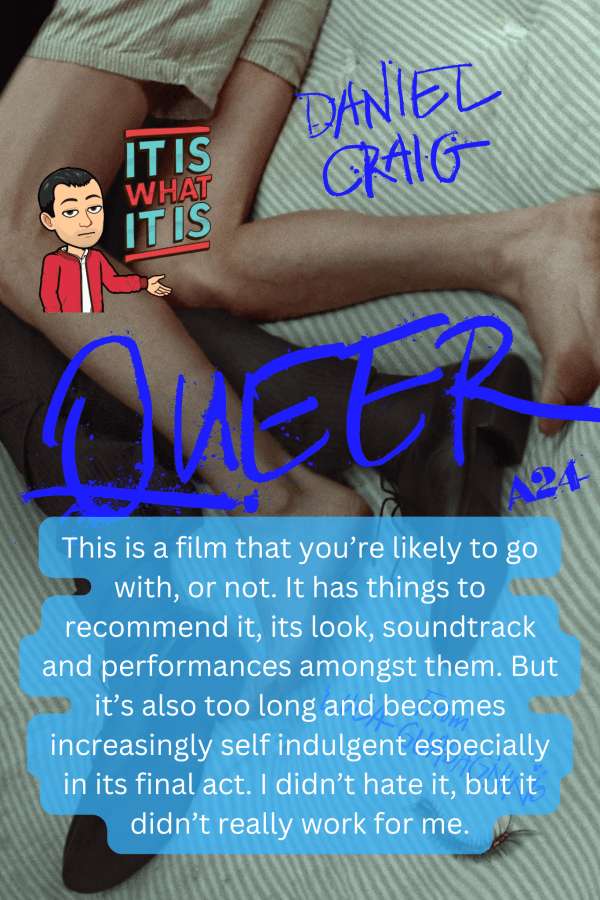
This is a film that you’re likely to go with, or not. It has things to recommend it, its look, soundtrack and performances amongst them. But it’s also too long and becomes increasingly self indulgent especially in its final act. I didn’t hate it, but it didn’t really work for me.

Blog at WordPress.com.

Up ↑

Design a site like this with WordPress.com
Get started