Mission: Impossible – The Final Reckoning

Director: Christopher McQuarrie

Ethan Hunt (Tom Cruise) is back and where we left him at the end of Dead Reckoning. He holds part of the key to defeating “The Entity” an AI that threatens to destroy all of humanity. The Entity’s human help, in the shape of Gabriel (Esai Morales), is there to stop him. Hunt’s mission, should he choose to accept it, is, as it was in Dead Reckoning, to find the Entity’s source code, poison it and destroy it. An adventure that will take him and his team across land, sea and air, in a high stakes battle for humanity’s future.

Where to start with this? It’s overly long, it has a nonsense story, a ridiculously unbelievable plot and most importantly it is a fanatically entertaining, wild rollercoaster of a film. It’s absolutely crazy and makes no sense and is brilliant for it.

This is not only how you make an action adventure, it is also the perfect example of how you should end a film franchise, it’s done at such a crazy scale, there is almost nowhere you could take it that wouldn’t feel a let down!

After it’s gentle start, this is a film that ramps up the tension and never stops, just when you think the film has taken you as far as it can, it ratchets up the stakes yet again.

It ticks all of the franchise boxes, self destructing tapes, face masks and all the crew are there with Ving Rhames, Simon Pegg, Henry Czerny as well as more recent additions includes Hayley Atwell, Pom Klementieff and the excellent Tramell Tillman. 

Perhaps its most impressive feat is this as the 8th film and you could watch this having not seen the others and still have a blast.

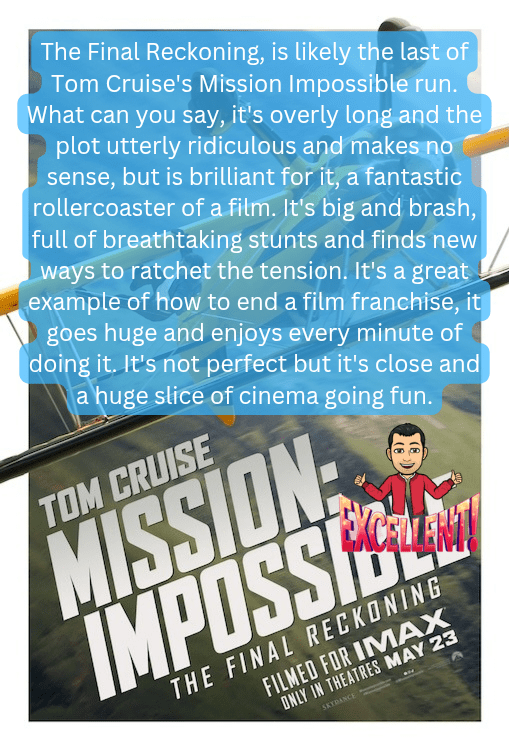
The Final Reckoning, is likely the last of Tom Cruise’s Mission Impossible run. What can you say, it’s overly long and the plot utterly ridiculous and makes no sense, but is brilliant for it, a fantastic rollercoaster of a film. It’s big and brash, full of breathtaking stunts and finds new ways to ratchet the tension. It’s a great example of how to end a film franchise, it goes huge and enjoys every minute of doing it. It’s not perfect but it’s close and a huge slice of cinema going fun.
The Salt Path

Director: Marianne Elliott

The Salt Path tells the true story of Raynor “Ray” (Gillian Anderson) and Moth (Jason Isaacs) Winn. Ray and Moth have had their lives turned upside down by homelessness and a devastating health diagnosis. In an attempt to deal with it, they decide to set off on a walk along England’s Devon and Cornwall coast, a walk that gives them a purpose and inspires and challenges them in equal measure.

If you wondered what it would be like watching two people out for a walk for just under two hours, then The Salt Path answers that question. It’s a very gentle film, that delivers exactly what you’d expect. And that is probably both its strength and weakness. 

On the plus side, it is a redemption story, a couple shook to their core by both  financial and health related trauma. But as they take their long walk, they begin to overcome, see new options and see the positives in their life. But on the downside, the first half particularly, seems relentlessly grim and as much of an endless plod as the walk itself. It feels like a lot of toil, to not get particularly far, and where you do get to feels predictable and not very far from where you started.

On the plus side, Jason Isaacs is a fine character actor who is always watchable and is so here. Gillian Anderson is a little harder work, with an accent that does as much wandering as her character does, and a facial expression that doesn’t overly change regardless of the situation.

The film looks great and will encourage plenty of trips to Devon and Cornwall. And if you love a metaphor this is for you! But overall I’m not sure it does the Winn’s inspirational story justice.

The Salt Path is exactly what you’d expect if you are going to watch two people out for a walk for two hours. It feels like hard going to ultimately take you where you expect. Jason Isaacs is eminently watchable, and does keep you engaged. And it does look great and if you love a metaphor this will be your kind of film. But ultimately I’m not sure it does the true story the justice it deserves.

The Phoenician Scheme

Director: Wes Anderson

Zsa-zsa Korda (Benicio del Toro) is a business man of questionable morals and regular plane crashes. After his latest scrape, he summons his daughter Liesl (Mia Threapleton), a trainee nun, and makes her the heir to his fortune. But there’s a catch, she must help him to complete his most ambitious, high risk, and likely to fail venture, his Phoenician Scheme. A scheme that is already in financial trouble, thanks to a secretive committee, whose exists to thwart Korda. The Korda’s accompanied by, Zsa-zsa’s tutor, Bjørn (Michael Cera), have a plan to meet with the investors and encourage them to plug the rather large gap in funds, using a bunch of schemes and cons to get there.

I have to admit, I do love the look and feel of a Wes Anderson film, and this was no exception. It ticks all the Anderson boxes. A starry cast, sumptuous colour, the fabulous symmetry of every shot and of course it’s story filled with quirky characters and fantastical story lines.

Its core characters. Del Toro, Cera and Mia Threapleton, carry the film with wonderful fun performances, but as always it’s the ensemble cast that help make it, Riz Ahmed, Benedict Cumberbatch, Jeffery Wright and Richard Ayoade all are particularly memorable.

The film’s storyline is perfect Anderson material. A heist style plot requiring many bits to fit together, works wonderfully with the elegant scene building that is such a signature of Anderson’s films.

The story is not perfect and does meander a little too much and isn’t Anderson at his most sharp. But that didn’t matter overly, as I so enjoy the worlds his films create, which are fabulous places to spend time.

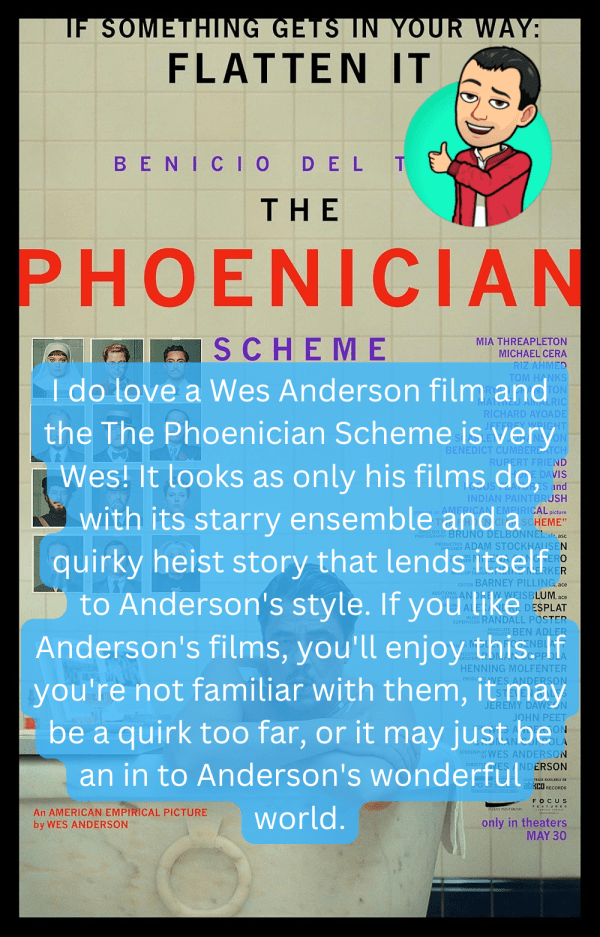
I do love a Wes Anderson film and the The Phoenician Scheme is very Wes! It looks as only his films do, with its starry ensemble and a quirky heist story that lends itself to Anderson’s style. If you like Anderson’s films, you’ll enjoy this. If you’re not familiar with them, it may be a quirk too far, or it may just be an in to Anderson’s wonderful world.

Hurry Up Tomorrow

Director: Trey Edward Shults

In Hurry Up Tomorrow we find a fictionalised version of Abel “The Weeknd” Tesfaye. Here as a man who is a “mess”, depressed and angry at the ending of a relationship. He has stress induced vocal problems, and is almost dragged on stage to perform by his friend and manager, Lee (Barry Keoghan). Alongside this is another lost and angry soul in Anima (Jenna Ortega) who has issues of her own. But when the two are involved in a chance meeting, it leads to a night neither expects and one that will change them.

Passion projects can be very dangerous things. Sometimes great but sometimes, like Hurry Up Tomorrow, can be ill disciplined, pretentious, nonsense.

There are plenty of problems with Hurry Up Tomorrow, but at the core of it, is a film that is not as clever and deep as it thinks it is. Much of the film is shot like a fever dream, mainly as a self pitying The Weeknd, mopes around about a lost love, who makes it clear in the voice messages we hear, that he was very much the problem. All his sadness represented by close ups and hazy lights covering the screen, none of which really works. It’s not helped by his irritating manager, played by the usually wonderful Barry Keoghan, but this performance feels like a real misstep.

All that said, it is not without some moments. All of which centre around Jenna Ortega, as the mysterious Anima, the film only really works or has any cohesion when she is on screen. Her character has issues and a story that would make a much more interesting film. The films only real highlight comes when Anima uses The Weeknds music as part of a bizarre but entertaining torture. And to Tesfaye’s credit his own performance is pretty solid.

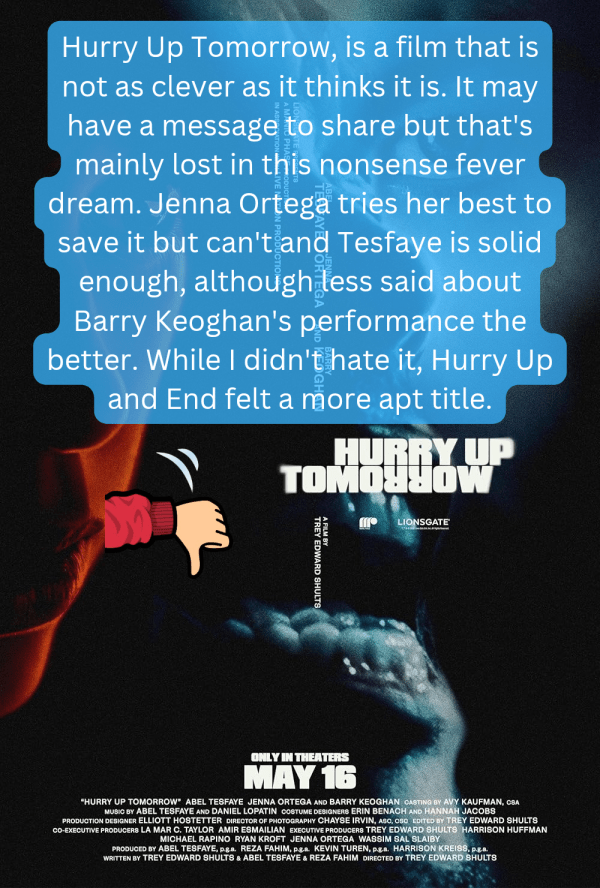
Hurry Up Tomorrow, is a film that is not as clever as it thinks it is. It may have a message to share but that’s mainly lost in this nonsense fever dream. Jenna Ortega tries her best to save it but can’t and Tesfaye is solid enough, although less said about Barry Keoghan’s performance the better. While I didn’t hate it, Hurry Up and End felt a more apt title.

Thunderbolts*

Director Jake Schreier

Yelena Belova (Florence Pugh) is disillusioned with her “cleaning up” job for Valentina Allegra de Fontaine (Julia Louis-Dreyfus). When offered the chance to change, after one last mission, Yelena finds herself brought together with some unlikely allies including John Walker (Wyatt Russell), Ghost (Hannah John-Kamen) and the mysterious, Bob (Lewis Pullman) a seemingly innocent member of the public. But, when a dark presence threatens New York, the unlikely group, with some help from Bucky Barnes (Sebastian Stan) and Yelena’s father Alexei, the Red Guardian (David Harbour), team together to take it on and become unlikely heroes.

Thunderbolts* is another attempt to restart the Marvel machine. While it’s not perfect, it is a much more successful than some other recent ones.

It’s a film that does try to do something a little different, with a story that mixes a light touch, with a much darker story that explores loneliness and depression, and does it pretty successfully.

The balance is helped hugely by the excellent Florence Pugh, whose Yelena has been a recent Marvel high point. She manages to bring both real fun, balanced perfectly with the gravitas that the darker elements of the story need to ensure they are handled with sensitivity. Her pairing with Pullman’s Bob is the serious heart of the film, while it’s her fun back and forth with Harbour’s Alexei that is its light heart.

The action is fun, but it’s not an action filled adventure it is attempting to be a bit more than that. However that does mean at times it’s a little glacial in its pacing. But overall a more than solid effort.

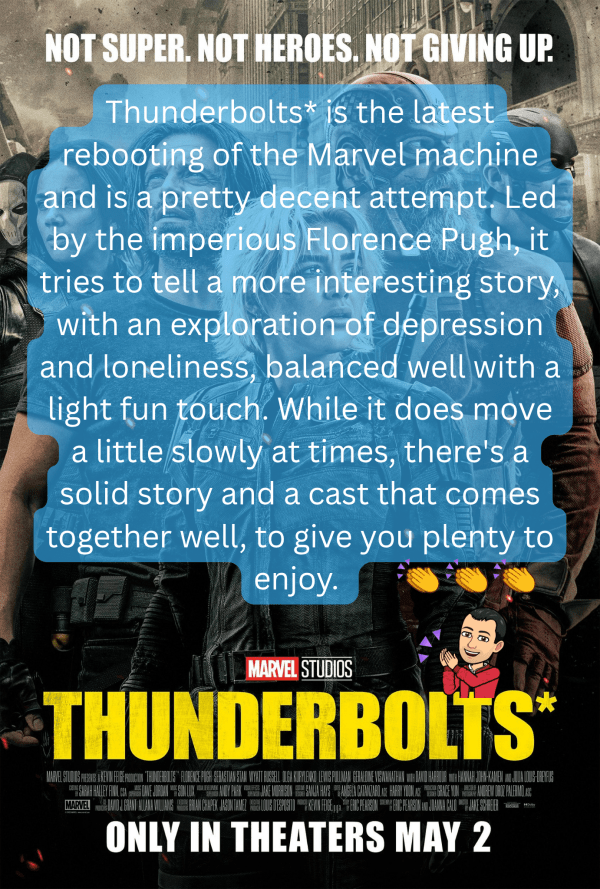
Thunderbolts* is the latest rebooting of the Marvel machine and is a pretty decent attempt. Led by the imperious Florence Pugh, it tries to tell a more interesting story, with an exploration of depression and loneliness, balanced well with a light fun touch. While it does move a little slowly at times, there’s a solid story and a cast that comes together well, to give you plenty to enjoy.

The Penguin Lessons

Director: Peter Cattaneo

This film is inspired by Tom Michell’s novel, The Penguin Lessons, telling the story of his time spent as an English teacher at an exclusive school in Argentina. Set in 1976 Michell (Steve Coogan) joins the school at the start of a military coup. After a few days in Uruguay, he finds himself returning to the school with a new friend, a penguin. The penguin soon becomes a key part of school life, helping Michell to inspire his students, a confidant to other staff members and helps Michell breakdown barriers and make friends. But life changes when the military police begin taking people from the streets and when this strikes close to home, Michell and his penguin become an inspiration to make a difference.

This is a film that is set against Argentina’s military dictatorship and the 30,000 people who “disappeared” under their control. But if you are looking for a gritty tense exploration of the Argentinian junta, this is not that film, rather, this is a gentle tale that focuses on transformation and inspiration, rather than the terrifying reality of a military dictatorship.

Coogan plays a role you’ve seen him in before, the world weary, cynic who carries the weight of his own tragedy and does it with warmth and wit. He’s well supported, Björn Gustafsson as a fellow teacher, Jonathan Pryce as the school headmaster, Vivian El Jaber, as school cleaner and grandmother and of course the Penguin(s) who brings quite the personality to the role!

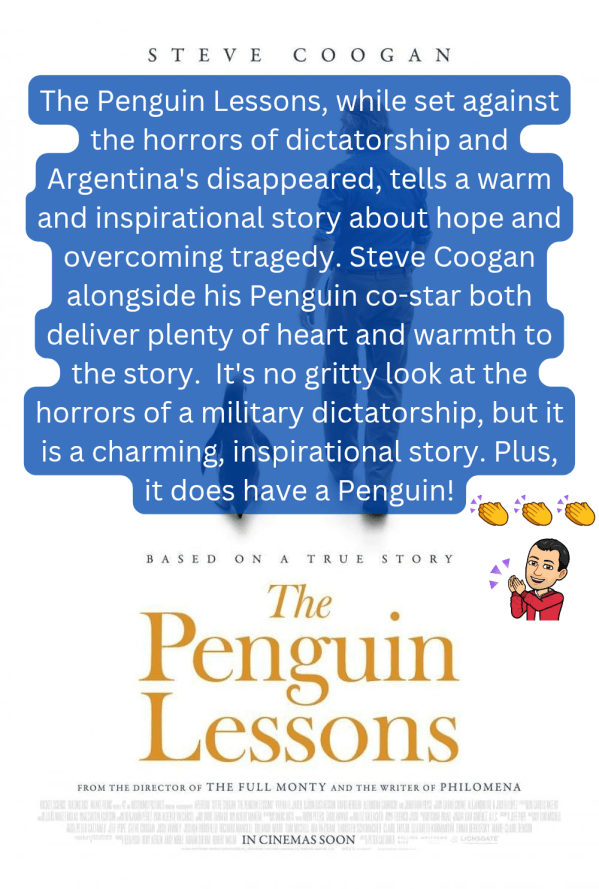
The Penguin Lessons, while set against the horrors of dictatorship and Argentina’s disappeared, tells a warm and inspirational story about hope and overcoming tragedy. Steve Coogan alongside his Penguin co-star both deliver plenty of heart and warmth to the story.  It’s no gritty look at the horrors of a military dictatorship, but it is a charming, inspirational story. Plus, it does have a Penguin!

Warfare

Writer/Directors: Ray Mendoza & Alex Garland

Set in Ramadi, Iraq in 2006, a platoon of Navy SEALs take control of an Iraqi family home to monitor the activities of local combatants, but when their position is compromised they come under heavy attack. Warfare tells their true story. 

Alex Garland, who directed the excellent Civil War, again places you right at the heart of a warzone. This time, using the recollections of his co-director, Ray Mendoza, and Mendoza’s platoon, to take you on an incredibly tense, stressful, and visceral 95 minute cinema journey.

This is not a war film that makes judgments. Nor is it a film about heroes and villains. Instead, it focuses on those impacted directly, the combatants and, in this case, an Iraqi family caught right in the centre. From the start, it builds a sense of foreboding, until an incident accelerates both the stakes and the pace of the action, sending you spiralling into a nerve-shredding, disorienting world of survival and terror.

This is not a film of big performances, but authentic ones. Each of the platoon is believable, Will Poulter, D’Pharaoh Woon-Awho and Cosmo Jarvis are at the heart of much of it, but none of the characters misses a beat.

It’s a film without a score. Instead, it uses the sights and sounds of this tight, enclosed space. It’s a soundscape, filled with explosions and bullets. Crackling radio messages as the units communicate with support teams. It’s moments of tense silence and of horrific pain. Amongst it are characters, who, while never panicked, are never in control, having to make countless immediate decisions that could be the difference between life and death.

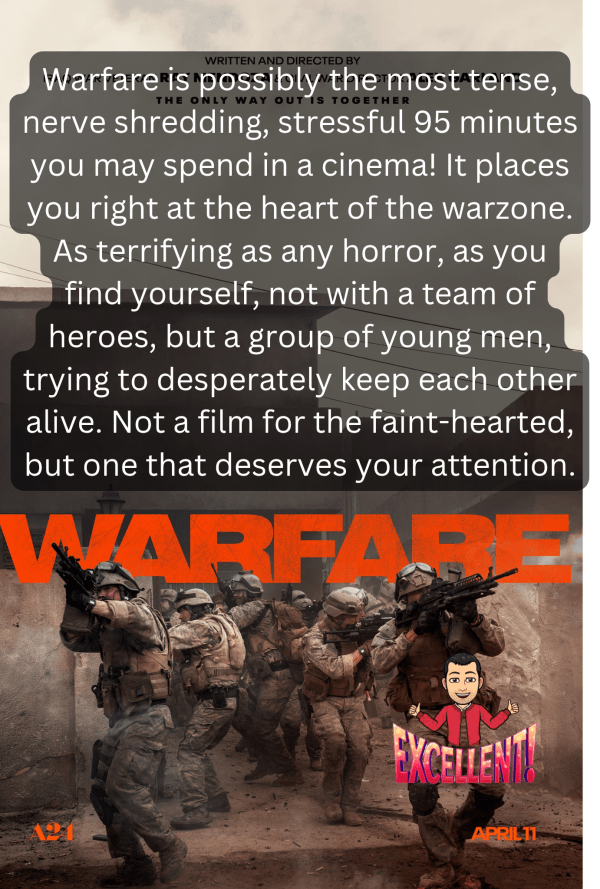
Warfare is possibly the most tense, nerve shredding, stressful 95 minutes you may spend in a cinema! It places you right at the heart of the warzone. As terrifying as any horror, as you find yourself, not with a team of heroes, but a group of young men, trying to desperately keep each other alive. Not a film for the faint-hearted, but one that deserves your attention.

The Amateur

Director: James Hawes

Charlie Heller (Rami Malek) is a technology and decryption expert. He is happily married to Sarah (Rachel Brosnahan), but his life changes when Sarah, on a business trip to London, is involved in a terror attack and killed. Devastated, he uses his skills to work out a timeline and identifies those responsible. He negotiates the chance to take revenge with his Langley bosses, but after training with a CIA operational expert (Laurence Fishburne), it becomes clear he’s no cold-hearted killer. But not to be deterred, he instead uses his skills, intelligence and determination to seek justice and revenge for his wife’s death.

I’m a fan of spy thrillers and love a bit of a caper, where smart people use ingenuity to set traps and pull off unlikely tasks. So on paper, The Amateur should have been an entertaining thriller. But for me it’s strangely inert, slow-moving, and even dull. All the ingredients are there but it really didn’t land for me.

Malek’s character is part of the problem. He’s a calm, smart, deliberate character but also very monotone. These characters really need something to grab your attention, a bit of wit and energy, and that is lacking.

Malek’s character isn’t helped by the slow-moving story, which has more holes than a colander. It starts with a very long setup before we get into Heller on his mission, but even then, the film only briefly bursts into life. It struggles to balance Heller’s angst with his drive for justice. It’s also disjointed, with storylines around the core story that never feel relevant or coherent.

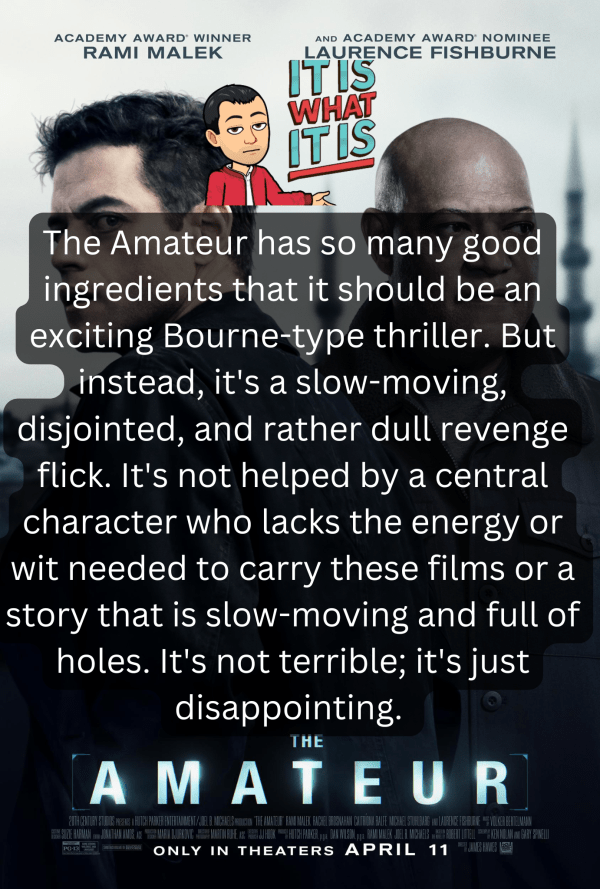
The Amateur has so many good ingredients that it should be an exciting Bourne-type thriller. But instead, it’s a slow-moving, disjointed, and rather dull revenge flick. It’s not helped by a central character who lacks the energy or wit needed to carry these films or a story that is slow-moving and full of holes. It’s not terrible; it’s just disappointing.

Death of a Unicorn

Writer/Director: Alex Scharfman

Elliot (Paul Rudd) and his daughter Ridley (Jenna Ortega) are heading to spend a weekend with his ill boss, Odell Leopold (Richard E. Grant), and his family (Téa Leoni and Will Poulter), in their impressive home, situated in a nature reserve they sponsor. Their weekend takes a turn when they hit a strange creature on the way to the house. It turns out it’s a Unicorn, a creature as magical as myth and legend suggests. But rather than take care of it, they try to exploit it, which has serious consequences for everyone involved.

This film delivers exactly what you expect from a comedy horror, home invasion,  Unicorns with attitude story. It’s not a film of major surprises, but it does deliver some tension, even if some of the story beats you see coming. Much you’ve seen before, although perhaps with more unicorns. It is silly, splattery fun, through its 107 minutes running time.

In the tradition of comedy horror, the film has a conscience. There are comments on “big pharma”, humanities endless attempts to exploit nature regardless of the consequences, the super wealthy looking after each other, the risks that come with greedy businessmen having influence rather than elected politicians and how people use “family” as a defence for the questionable decisions they make.

There are plenty of enjoyable performances. Ortega and Rudd at its heart, while Richard E. Grant laps up the self-obsessed superrich with delusions of immortality. Will Poulter is the pampered and equally delusional billionaire child. Sunita Mani provides good support as a scientist who soon becomes disillusioned with the rich people’s folly. Anthony Carrigan often steals the show as the put-upon Butler Griff.

Death of a Unicorn is an entertaining, if likely unmemorable, comedy horror. It’s as silly as its premise suggests, with some splattery fun, social commentary, and home invasion tension, all wrapped up with unicorns! While there’s not much original, if you want some dark fun with unicorns, this will suit you nicely!

Flow

Writer & Director: Gints Zilbalodis

Writer: Matīss Kaža

Flow is set in a flooded land where the only inhabitants seem to be animals, both domesticated and wild. When the water levels continue to rise, a timid and isolated cat realises it must find safe land. But the cat can’t do it alone and needs to learn to trust in others to survive. On its adventures the cat finds a group of similarly stranded animals including a Dog, Lemur, Capybara and a Secretarybird, who together set sail on a boat to travel the water filled lands to find safety.

Flow is an Oscar winning, dialogue free, survival adventure. Using animals rather than humans, it tells a touching tale of bravery, ingenuity, trust and most importantly friendship.

Even without a word of dialogue or any obvious anthropomorphic transformation of its animal cast, you fully buy into the individual personalities of each of the animals at the story’s centre. The cat, in particular. takes you on a journey and engages you with every look, purr, and movement. Together, you see the animals bond as they learn to overcome their differences, work together, and help each other survive the challenges in front of them.

It’s gorgeously animated, the animals are not meant to be  photo realistic but give you all you need to see every character nuance. The landscape is hugely detailed, especially the incredible animation of the water and the life in it.

The film does have some mild peril and its moments of tension, but overall it’s a wonderfully told, animal based action adventure, suitable for the young and not so young.

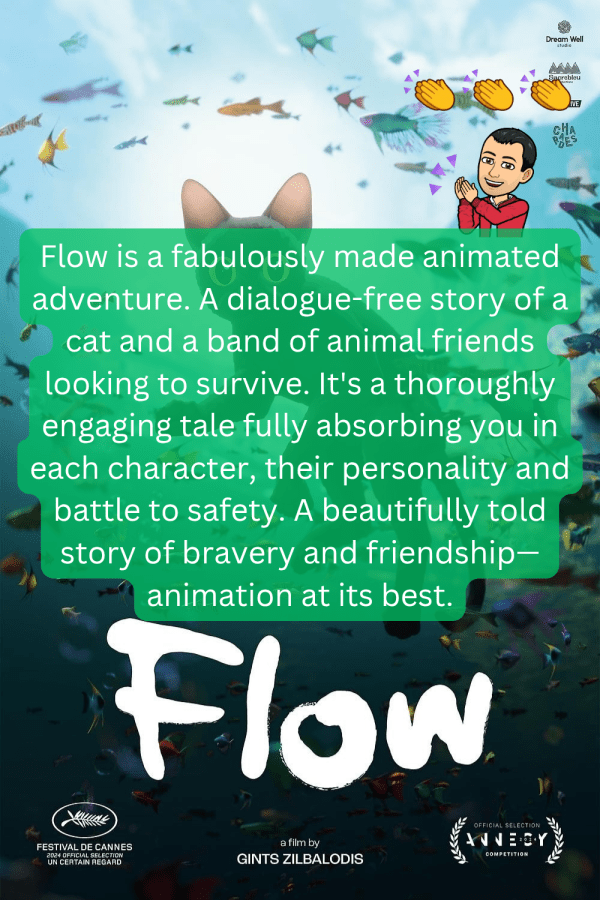
Flow is a fabulously made animated adventure. A dialogue-free story of a cat and a band of animal friends looking to survive. It’s a thoroughly engaging tale fully absorbing you in each character, their personality and battle to safety. A beautifully told story of bravery and friendship—animation at its best.

Blog at WordPress.com.

Up ↑

Design a site like this with WordPress.com
Get started