The Fabelmans

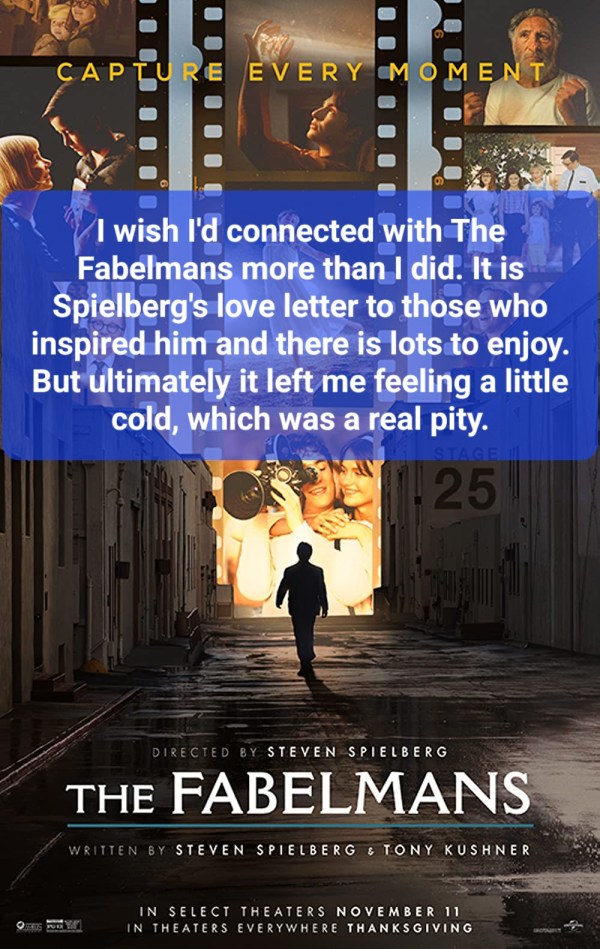
Steven Spielberg directs and co-writes, with Tony Kushner, this semi autobiographical story of growing up and finding your passion. We follow Sammy Fabelman (Mateo Zoryan plays the young version and Gabriel Labelle the older) who discovers cinema at a young age. He is fascinated and wants to learn how to create the same magic. His father Burt (Paul Dano) is a very talented computer engineer, analytical and driven and sees his son’s passion as no more than a hobby. Mitzi (Michelle Williams) his mother is a talented musician an artist and a dreamer, who believes in his dream. It is in this environment he tries to follow his passion. This passion is his constant and sees him through house moves, anti-Semitism, bullying, his first love and family breakdown.

The Fabelmans has a lot of awards buzz. But I have to say it left me rather cold. It’s not a terrible film and I’m not 100% sure why I didn’t connect with it.

The opening act is beautiful the young Sammy finding the wonder of cinema and his exploration of how to make film is mesmerising. Its final act, including a wonderful final scene, is equally entertaining, maybe less heart warming, but joyous as Sammy finally moves towards fulfilling his dream.

It’s the middle portion of the film I struggled with as his family starts to disintegrate and I found it a hard to have any empathy for Mitzi for the position she puts the family in. That’s not a reflection of the performance, Michelle Williams is excellent as the increasingly unstable Mitzi. But her story was annoying rather than engaging.

Performances are great throughout Paul Dano perfectly balances Mitzi’s excesses as a “good man”. Seth Rogen, Judd Hirsch and especially Chloe East as Sammy’s Jesus loving first love all add plenty. And Gabriel Labelle is really engaging playing Sammy.

I wish I’d connected with The Fabelmans more than I did. It is Spielberg’s love letter to those who inspired him and there is lots to enjoy. But ultimately it left me feeling a little cold, which was a real pity.

Babylon

Damien Chazelle writes and directs this tale of 1920’s and 30’s excess set in and around the early Hollywood movie industry. Jack Conrad (Brad’s Pitt) is a major studio offering guaranteed box office. This comes with perks, he’s the king of his domain, he is the party and when they party they party big. We find Jack at the most decadent of parties sex, drugs, naked bodies everywhere and of course an elephant. Here we meet Manny (Diego Calva) a gopher for the rich with dreams of making movies and Nellie LaRoy (Margot Robbie) a “wild child” with dreams if starring in films. We follow their lives as they navigate a world of excess and a film industry that is in flux as “talkies” emerge and those that don’t fit find themselves callously dumped.

I’m a big fan of Damien Chazelle’s movie and TV work and here he takes a big swing at telling an epic story that runs just over 3 hours. I do admire big swings but sometimes, as with Babylon, they don’t quite catch it right and it falls short.

There are plenty of things to enjoy during its running time. Chazelle always uses music fabulously well and he does here and his direction often feels like a dance as we often find ourselves skilfully moving through busy complex scenes.

There’s plenty of performances to enjoy, Brad Pitt particularly as he takes us on Jack’s downward spiral. Margot Robbie’s Nellie the out of control young star who is equally popular and lonely, Robbie portrays this perfectly. Alongside them Jean Smart, Diego Calva and a cameo from Tobey Maguire all add to the tale.

However there is a lot going on and not all of it comes together, the narrative is sometimes a mess and sometimes self indulgent which leads to it 3 hours plus running time.

There’s no doubt Chazelle is steeped in film history and with this he wants to honour an important and pivotal part of it. But in wanting to tell such a big story it feels it often gets a little lost.

Babylon is an epic and wants to tell a big sweeping story. However it doesn’t fully succeed, as it tries to tell too much and indulge itself as much as the Hollywood of the time and that shows in its long running time. It’s likely to be divisive too much of a mess for some, but for others a 3 hour romp through movie history.

Tár

Todd Field writes and directs this story of control, infidelity and mental health all set in the world of classical music. Cate Blanchett is Lydia Tár, the first female lead conducter at the world famous Berlin Philharmonic. She is well respected jetting between the US where she guests as a lecturer at Juilliard. Her passion is the work of composer Mahler whose work she is recording. While doing this she also is balancing her family life with her wife Sharon (Nina Hoss) and their daughter Petra. While also releasing her memoirs, trying to compose her own music and prepare the orchestra to perform and record Maher five the last of nine pieces. However the tragic suicide of a former colleague begins a process that starts to unravel Tár’s life taking her on a painful downward spiral.

This film may not be for everyone there is a lot here and it takes its time telling its story. But personally I found it intriguing and absorbing a film. Its orchestral setting helps naturally bring a tension and energy in the way of something like Whiplash.

But at the real heart of what makes this work is an incredible performance from Cate Blanchett, completely believable and her presence absorbing and engaging throughout. Her character is successful, but belligerent, controlling and abusive. She lives in a world where historically men have dominated and have behaved as she has and she believes this to be fine. But as her world unravels Blanchett brings this to screen perfectly as her character becomes increasingly desperate.

The supporting cast are also strong Nina Hoss, Noémie Merlant and Sophie Kauer all shine around Blanchetts central whirlwind.

The score as you’d expect is fabulous in bringing the pace and frenetic nature of the story to life.The film can be slow moving at times and probably over runs a little, but it does lead to a satisfying end.

Tár is for me an intriguing and compelling watch. Built on a fabulous performance by Cate Blanchett who takes you on an increasingly desperate downward spiral. It won’t be for everyone, but worked a treat for me.

Empire of Light

Written and directed by Sam Mendes is this film of life amongst a group of cinema workers, set in a 1980’s English sea side town. Olivia Colman is Hilary, assistant manager of the Empire theatre. She seems happy and enjoys the community that the small team gives her. However she also has a history that is initially alluded to but not explained. When cinema manager Donald (Colin Firth) introduces Stephen (Michael Ward),a young black man, to the team he has a big impact on them all and Hilary especially. The film explores themes of 1980’s Britain its music, its attitudes to mental health and race, but also how these broad themes impact the individuals who work at the Empire.

If there is a probem with Empire of Light, it is the unevenness of its narrative. That doesn’t make it a bad film, but probably explains the mixed reviews it has received. It is perhaps beat summed up when projectionist Norman (Toby Jones) describes how film works, images with dark bits between them, but when played at 24 frames per second you don’t see the dark bits. That is what Empire of Light tried to show, that as life hurrys by it works, but when you stop and look at the gaps in between you can see something very different.

The film revolves around Hilary, as her relationship with Stephen develops and impacts her. We see her change as her life descends into the darkest of places. Colman is of course outstanding and I don’t think there is anyone else who plays this type of role better. Toby Jones brings his effortless quality to the screen as does Colin Firth. Michael Ward brings an engaging charm as Stephen showing a caring individual dealing with the ugliness of the racism that surrounds him. It also looks fabulous thanks to Roger Deakins cinematography.

Empire of Light is flawed, with a narrative that is a bit unclear. But I was won over by its beauty, heart and the quality of its performances. None more than that of Olivia Colman who is as wonderfully watchable as ever. Not perfect but touching and warm and there is nothing wrong with that.

White Noise

Noah Baumbach directs his own adaptation of Don Delillo’s book. Adam Driver is Jack a professor in Hitler studies at the local college. His wife Babette (Greta Gerwig) is mum to their three children and runs classes for seniors. They spend their time dealing with the mundanity of life, trips to a beautifully colour coordinated supermarket and work. Life changes after a train crash which forces them to revaluate life and the impact of death.

For me White Noise is a very odd film, some of it works, some of it less so. It’s at its best during its second act when it moves from introspective look at life to part disaster movie part allegorical tale of an unseen threat that forces humanity to act in unusual ways.

There’s are also some interesting observations around stories and the subtle use of misinformation. As the title suggests a lot of this happens in the background a gentle hum of conversation and background chatter. There is also an entertaining final part to the film which includes German nuns and a supermarket scene that keeps in line with the oddity of all that preceded it.

I do enjoy a quirky film, however this often felt too quirky for its own good and not quite as clever as it thought it was, often disappearing into its own oddity.

That said Adam Drivers presence does hold it together and he gets good support from Don Cheadle. The film also looks great, recreating it’s 1980’s look with brown and yellow tones mixed with bright colours.

White Noise overall didn’t work for me, but was by no means terrible. In Adam Driver you always get a compelling lead and the second act works really well. But to often it feels muddled and a little too much hard work to stay engaged with. In the end as its name suggests it is that background noise that occasionally gets your attention.

Till

Based on Keith Beauchamp’s investigative work and directed by Chinonye Chukwu is the telling of the true story of the murder of 14 year old Emmett Till. Mamie Till (Danielle Deadwyler) is a single mother bringing up her son Emmett (Jalyn Hall) in 1950’s Chicago. At 14 he is keen to head to Mississippi to spend time with his cousins. Mamie is concerned, as a black woman who grew up in the south, she knows the different world her son will be visiting. Her worries are not unfounded and when Emmett has an interaction with white shopkeeper Carolyn Bryant (Hayley Bennett), it starts a chain of events that leads a lynch mob kidnapping Emmet. A few days later his beaten, mutilated, murdered body is found in a river. When Emmett’s body is returned to Chicago and Mamie sees his mutilated body she wants America to see what was done to him. His open casket funeral leads to national coverage of the disgusting crime and Mamie to Mississippi to testify at the trial of the perpetrators.

The abhorrent reality of Emmett’s murder is always going to be more impactful than any dramatisation. Chukwu realises this so rather he focuses on Mamie and everything that the horror of her child’s death brings

It is this study of her anguish were the film is at its best. It lets its impressive star, Danielle Deadwyler, shine brightly as she portrays powerfully and movingly a mother’s life crashing around her in the most horrific way.

Outside of this, a bit like with the recent She Said, the importance of telling this story overcomes some of the deficiencies in how it is told. As it does sometime struggles to balance the tough reality with the character study.

The film also looks incredible thanks to Bobby Bukowski’s wonderful cinematography.

While the film has some deficiencies it is made up for by Danielle Deadwyler’s outstanding central portrayal of grief and drive for justice for her child. The abhorrent crime at its center deserves to be understood and for that reason it makes Till more than worth a watch.

A Man Called Otto

Marc Foster with screenwriter David Magee bring to screen this adaptation of Fredrick Backman’s book. Otto (Tom Hanks) is in his mid 60’s, a widower about to retire. He lives on a small private road, hassled by property developers and, in his mind, surrounded by idiots. All has taken its toll, he’s fed up and annoyed with life and his only thought is to rejoin his wife Sonya. We see Otto’s past through flashback with Hank’s son Truman playing the young Otto alongside Rachel Keller as Sonya. Otto’s life is changed when new neighbours move in, in the shape of Marisol (Mariana Treviño) her husband Tommy (Manuel Garcia-Rulfo) and their young family, who begin to give Otto purpose in his life as realises that maybe not everyone is an idiot and life still has purpose.

If you have ever seen Clint Eastwood’s Gran Torino and wondered what it would be like with Tom Hanks in the lead role, then this is your answer. Ultimately it’s a pretty predictable story, Grumpy older man fed up with life finds purpose in unexpected relationships.

But predictable doesn’t mean bad. Now while this is unlikely to be hugely memorable it is enjoyable and delivered with a huge slice of charm. That charm comes on occasion from the good hearted story, but mainly it comes from an excellent set of performances. It’s no surprise to anyone that Tom Hanks is his usual charismatic self and he does grumpy very well. But the film is at its best in his interactions with Treviño’s Marisol, she brings a real humour and heart to the roll. There is good support elsewhere with Juanita Jennings as Anita, Cameron Britton’s Jimmy and Mack Bayda as Malcolm amongst the picks.

A Man Called Otto is predictable and pedestrian at times. But Hanks and Mariana Treviño bring so much charm and warmth to the screen that you can’t help been carried along. Ultimately delivering an enjoyable good hearted story.

Avatar: The Way Of Water

It’s thirteen years since James Cameron introduced the world of Avatar. Time has passed since Jake (Sam Worthington) went native, swapping his consciousness fully into his Avatar. He and his mate Neytiri (Zoe Saldana) have a family and a peaceful life. However that changes when the sky people return with a new mission, to make the planet their home and quell any dissention from the natives. The team is led by the Avatar of Quaritch (Stephen Lang), who knows to do this must gain revenge on Jake and Neytiri and will destroy anything in his path to achieve it. Jake realises to keep his family and the tree people safe he must run. So they head off to the islands of the water people and seek the protection of Tonowari (Cliff Curtis) and Ronal (Kate Winslet). But ultimately this brings to war to the water people and leaves Jake with no option but to fight.

The first Avatar was far from perfect, but was technically impressive and wowed audiences. Whether that warrants a sequel let alone a series of films is questionable and The Way Of Water does little to dispel the idea that Cameron’s creation lacks the story ideas to carry a series of films.

Like the first the second film is far from perfect but isn’t unenjoyable. It looks impressive with some engaging world building and great action set pieces fantastically realised.

But it also has the same issues. The main one is the paper thin story, it’s a 40 minute story stretched over 3 hours. The knock on effect is lots of padding especially in the middle third where the kids seem to be endlessly bonding with nature and each other. While it doesn’t overly drag, by the final act you are certainly starting to wonder “are we there yet”.

But for those criticisms there is still plenty of enjoyable parts.

The Way Of Water is overly long and lacks the story to sustain it and feels more interested in technology than narrative. But it is a grand scale cinematic experience and at times an enjoyable one. It probably is worth seeing for the experience, but how good it is will feed debate for some time.

Glass Onion: A Knives Out Mystery

Three years after Knives Out, Rian Johnson brings Benoit Blanc back to the screen. It is lockdown and it’s driving Blanc (Daniel Craig) crazy and he is desperate for a case to distract him. It comes when he receives an invite from billionaire Miles Bron (Edward Norton) to join him and his friends on his private island for a murder mystery weekend. His friends are an eclectic mix of “influencers” Birdie Jay (Kate Hudson) a former model come fashion designer, Duke (Dave Bautista) a man’s rights activist, politician Claire (Kathryn Hahn) and scientist Lionel (Leslie Odom Jr.). Alongside these is Bron’s former business partner Andi (Janelle Monae). When they arrive at the island it becomes clear to Blanc that the relationships are not what they seem and the murder mystery is no game.

2019’s Knives Out was one of the best films of the year. So a second mystery featuring Craig’s smart detective was not risk free. Luckily Johnson does not let anyone down with this fun “whodunnit” romp.

While it doesn’t quite have the impact of the first, partly because of raised expectation and possibly, for most, this is Netflix only experience. That said this is a more than passible follow up.

It has a twisting turning mystery, a sharp script that zips along and a satisfyingly layered story. Most importantly it has a cast which feels like they are having a great time inhabiting their characters. Janelle Monae is excellent as the mysteries protagonist. Kate Hudson is clearly having a great time as the vacuous Birdie and Norton gets the balance right as the “at all costs” billionaire.

Of course the star is Craig’s Blanc. Poirot in a cotton suite and a southern US drawl, a role he pulls off with style and a perfect comedic light touch.

Glass Onion is a fitting Knives Out mystery. Its smart story keeps you guessing and the cast is having a great time carrying you along for the ride. Fans of the first and those new to Knives Out won’t be disappointed and will be looking forward to the third film as soon as it finishes. Just a pity it’s not in the cinema.

Spirited

Available on Apple TV+.

Sean Anders writes and directs this latest loose reworking of A Christmas Carol. The ghosts of Present (Will Ferrell), Past (Sunita Mani) and To-come (Loren G Woods and Tracy Morgan) are planning next year’s haunting. However, this one is a challenge an “Unredeemable” Clint Briggs (Ryan Reynolds), someone beyond redemption, is the target and this is something that has only been tried once before. Briggs turns out to be as much of a challenge as the Ghosts and their boss Jacob Marley (Patrick Page) had feared. As the ghosts try to redeem him, he turns the tables on them, especially the ghost of Present. There are other complications for Present too as he meets Briggs head of media strategy Kimberly (Octavia Spencer) who makes him think of the life he never had. Will the ghosts manage to sing and dance their way to another successful redemption?

Ryan Reynolds, Will Ferrell and a musical reworking of A Christmas Carol, sounds fun in theory. Luckily in practice, it was as much fun as you’d expect and I mean that in a good way.

It’s more Scrooged than Scrooge and is a good successor to Bill Murray’s classic Christmas favourite. Ferrell and Reynolds, who so easily could have “dialled it in” fully embrace the silliness of the story and throw themselves wholeheartedly into the many song and dance routines, most of them work well and there’s a lot of fun to be had with the “good afternoon” song, which includes a wonderful if very brief cameo.

The two leads are well supported by the always reliable Octavia Spencer who also turns in some enjoyable musical performances of her own. The script zips along most of the time, although it does feel a bit baggy towards the end.

Spirited is as fun a romp as it sounds Reynolds and Ferrell energetically embrace the catchy song and dance numbers and deliver an entertaining play on the Christmas Carol story. A film that was as enjoyable as you’d hope and destined for plenty of future Christmas replays.

Blog at WordPress.com.

Up ↑

Design a site like this with WordPress.com
Get started